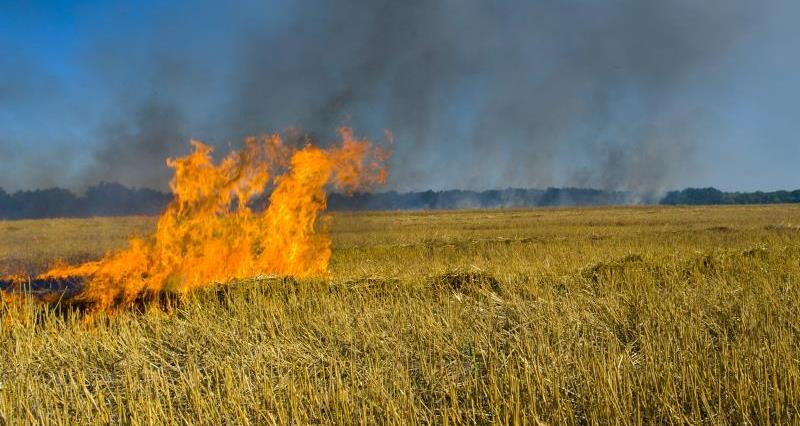
The NFU is urging the government to develop a National Wildfire Strategy for England and Wales, in response to the increasing threat wildfire poses to farm land and rural communities.
In 2025, the wildfire season saw nearly 48,000 hectares burned across the UK, seven times the annual average recorded between 2006 and 2024.
And with the current period of record-breaking heatwaves seen across the UK, coupled with a prolonged lack of rainfall and current strong winds, parts of England have been assessed as being at “exceptional" or "very high" risk of wildfire.
Not only does this put livestock and crops at risk, but people’s safety, their homes, and those of their neighbours too, as fires can spread quickly and unpredictably.
“The NFU is calling on government to develop a National Wildfire Strategy which sets out clear guidelines for wildfire prevention, preparedness, and response. This plan must recognise the vital role farmers play in assisting emergency services when action is needed to resolve wildfires.”
NFU Vice-president Robyn Munt
Reducing the risk
In a response a recent Efra Committee inquiry on wildfire risk and response, the NFU highlighted active vegetation management, including grazing, controlled burning, and mechanical management, as the most effective tool available for reducing wildfire risk.
However current agricultural and environmental policy restrict this from happening.
As such, the NFU is calling for an urgent review of the Heather and Grassland Burning Regulations 2025, highlighting concerns that the regulations were introduced without a thorough wildfire risk impact assessment.
NFU Vice-president Robyn Munt said: “As the impacts of our changing climate becomes clearer, maintaining active land management is important, particularly in the uplands, through sustainable livestock grazing and the continued use of controlled burning.
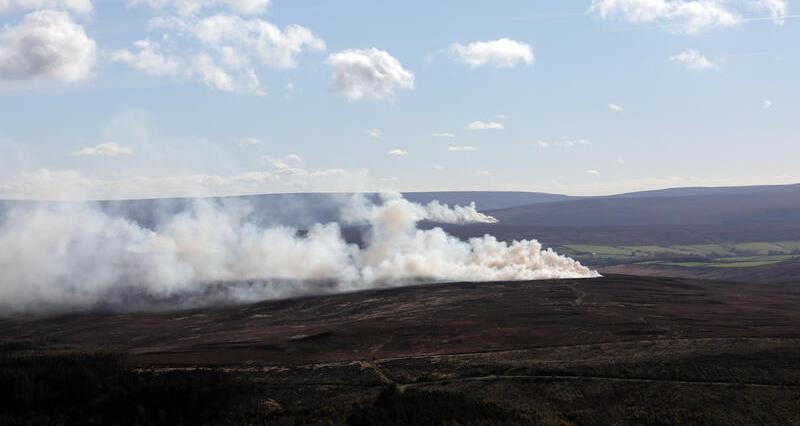
“When carried out responsibly and in accordance with regulations, this can help manage vegetation and reduce the risk of moorland fires in dry conditions.
Additionally, the NFU says rural emergency services require dedicated wildfire training, equipment, and funding to enable them to respond to wildfires. Their ability to do so is often constrained by poor access and limited water supplies.
Instead, farmers and land managers often act as first responders, using local knowledge and equipment, putting emphasis on the important role farmers play in land management – maintaining tracks, firebreaks and water points.
Robyn continued: “The NFU is also calling on government to develop a National Wildfire Strategy which sets out clear guidelines for wildfire prevention, preparedness, and response and should apply to all relevant bodies including Fire and Rescue Services, local authorities, Natural England, Forestry Commission and Highways England.
“This plan must also recognise the vital role farmers play in assisting emergency services when action is needed to resolve wildfires.”
Public awareness
Nearly all wildfires are caused by human error, and the NFU has long-called for year-round awareness and promotion of responsible behaviour in the countryside, recently renewing its own communications on the importance of following the Countryside Code.
“As the heatwave continues, we’re urging everyone who enjoys the great British countryside to play their part and be fire-aware, so these shared spaces remain safe and accessible for all," Robyn said.0
“Please follow the Countryside Code, avoid open fires and report any signs of fire immediately.”
‘I dread to think how bad it would’ve been’
Sadly, British farmers are all too familiar with the serious threat wildfire poses to the countryside.
Many farmers put themselves into incredibly challenging conditions, working tirelessly to protect rural communities and care for the landscapes.
A Lincolnshire farmer was named NFU Community Farming Hero for the East Midlands in 2022 for playing a vital role in delivering a farm fire training programme and developing an adapter that enables firefighter access to on-farm water bowsers helping to save lives, property, livestock and crops.
This adapter is being used in counties such as Lincolnshire and Norfolk, but in most other counties, fire engine fittings are still not compatible with rural water storage systems, making a farm fire outbreak harder to manage.
Lincolnshire arable farmers and NFU members Andrew Ward and Rhonda Thompson have first-hand experience of the importance of these adapters when part of their farm went up in flames.
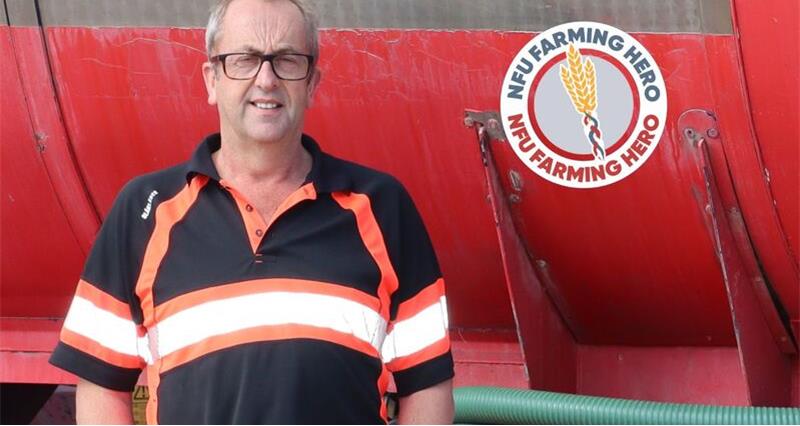
Rhonda said: “It was awful to get the call from a neighbour that our poultry manure heap was on fire, which is surrounded by thousands of acres of wheat – both our own and neighbouring farmers’.
“Every minute the fire was unattended added to the risk of it breaking over into the crop, where it would’ve spread quickly to neighbouring farms and been much harder to contain. Two fire engines arrived quickly from Nottinghamshire and Lincolnshire and, fortunately, the Lincolnshire fire engine was carrying the adapter.
“I dread to think how bad it would’ve been if the firefighters didn’t have access to our on-farm water stores and neighbours’ water bowsers and tankers. Sadly, that’s the situation facing most farms across the country without this adapter.”