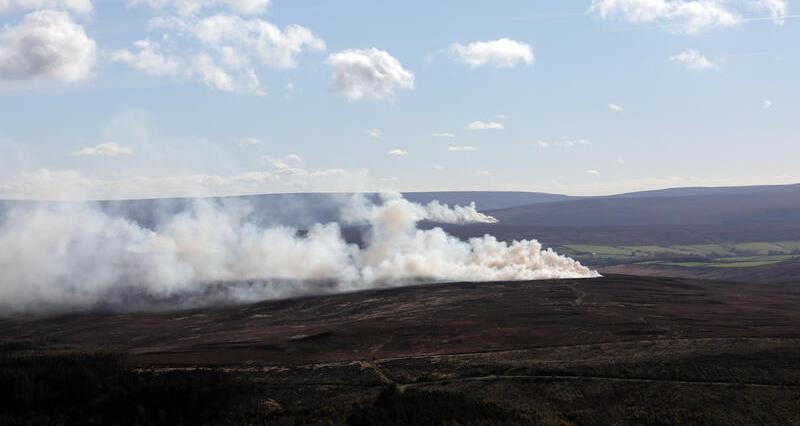
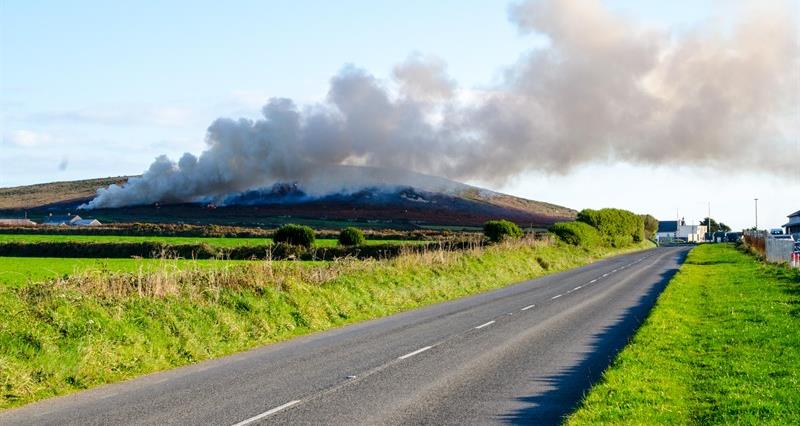
The risk of wildfires is prevalent and ever growing.
On this page you will find practical guidance on responding to incidents, gathering evidence and making the case for local restrictions and stronger national measures to reduce wildfire risk.
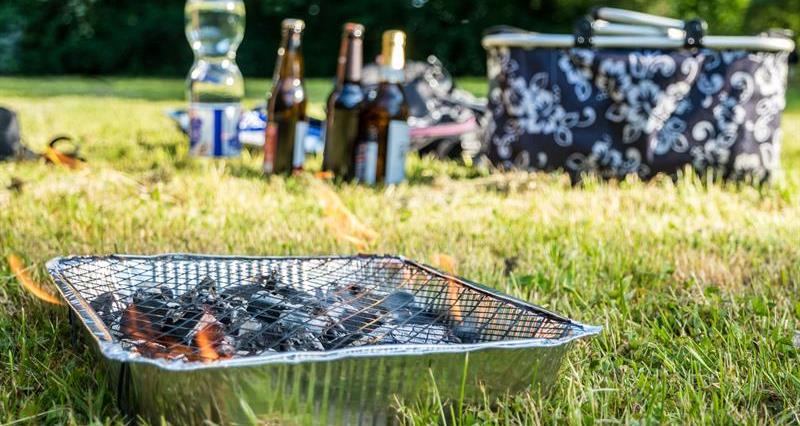
Fires can be caused by portable barbecues, campfires, discarded cigarettes, matches, glass bottles, machinery and deliberate arson.
One method of control that members have is applying for a PSPO (Public Spaces Protection Order). PSPOs cannot be introduced on a national scale – they can only be made by individual local authorities, within specified areas, to address local issues.
Before introducing a PSPO, a local authority must be satisfied that the effect of the activities is, or is likely to be:
- persistent or continuing;
- unreasonable; and
- justifies the restrictions being imposed.
Gathering the relevant evidence you need when applying for a PSPO will be critical.
Here’s what to do:
How to gather evidence
If it is not safe to approach the site, call the fire brigade and/or the police.
Here is a step-by-step guide on what to record if you find a disposable barbecues on your land.
When and where?
Note the date, time, and location of the incident.
You can use GPS, what3words or a field number.
If you are using a phone to take your picture, location details will also be stored with the image on your phone.
Photo evidence
Before any clean up begins, take photographs of:
- the fire scene
- burnt area
- disposable barbecues remains
- associated litter and packaging
- damage to crops, grassland, woodland, fences, buildings or machinery.
Record notes
To help with recollection, take notes describing:
- how the fire was discovered
- suspected cause
- weather conditions (wind, dry vegetation, recent rainfall)
Were there any witnesses?
If anyone saw the BBQ in use, collect their details.
Incident numbers
Note the Fire and Rescue Service incident number (if attended) and the police incident number (if reported)
Estimations
Record estimates of:
- area damaged
- crop losses
- fencing or infrastructure losses
- contractor costs for reinstatement
Also gather receipts and invoices for emergency works undertaken to make the site safe.
5-step process to apply for a PSPO
Talk to your NFU regional and county teams who can help you build a strong evidence base, support and present proposals to the local council.
Your local NFU teams can:
1. Collate any evidence
This can include:
- incident records from other members
- incident reports
- police crime or anti-social behaviour data
- fire service reports (if relevant to wildfire risk)
- landowner and resident testimonials.
2. Build local support
This can be achieved by engaging with parish councils, councillors, MPs and Police and Crime Commissioners.
It is also important to seek support from local residents, businesses, affected landowners and community groups.
3. Present a clear proposal
- Define precisely what behaviour should be restricted.
- Identify the geographical area.
- Explain why existing powers are insufficient.
- Demonstrate that the proposed restrictions are proportionate.
4. Engage with councils early
- Meet the community safety, legal or anti-social behaviour teams.
- Ask whether they have considered a PSPO previously.
- Offer evidence and stakeholder support to assist their consultation.
5. Participate in the consultation
Once the strong evidence base has been gathered and submitted, there will be a consultation process where councils will assess whether a PSPO is the most appropriate tool and consider alternative solutions.
The consultation will be undertaken with key stakeholders, including the local chief officer of police, the PCC (police and crime commissioner), owners or occupiers of land within the affected area, and appropriate community representatives.
Councils will reach out to potential respondents in a diverse range of ways to target different demographics, including social media, surveys or questionnaires, meetings and written statements.
If you want to share evidence of incidents involving single-use BBQs on their land, you can email [email protected].
Public Spaces Protection Orders explained
A PSPO is a powerful tool at a local level to enhance wildfire prevention and enforcement measures.
PSPOs have the power to restrict activities that increase the risk of wildfires, such as the use of disposable BBQs or the lighting of fires in high-risk public areas.
A PSPO is a legal tool under the Anti-social Behaviour, Crime and Policing Act 2014 that local authorities can use to prohibit specified activities in public places where those activities have had, or are likely to have, a detrimental effect on the quality of life of people in the area.
The NFU can lobby local authorities to consider introducing a PSPO where appropriate, providing evidence of impact on the area.
Before introducing a PSPO, a local authority must be satisfied that the effect of the activities is, or is likely to be:
- persistent or continuing;
- unreasonable; and
- justifies the restrictions being imposed.
PSPOs cannot be introduced on a national scale – they can only be made by individual local authorities, within specified areas, to address local issues.
A PSPO can be introduced for a maximum of three years and can be extended if certain criteria are met. Extensions of a maximum of three years can be repeated after evaluation.
Case study: High Peak PSPO
High Peak Borough Council introduced a PSPO to help reduce wildfire risk across vulnerable moorland and open land areas. The order restricts activities such as lighting fires, using barbecues, setting off fireworks, and releasing sky lanterns where these activities could threaten public safety, property, wildlife habitats and the environment.
Read: Public Spaces Protection Orders | GOV.UK
The approach combines enforcement, including Fixed Penalty Notices and prosecution where appropriate, with public awareness campaigns to encourage responsible behaviour. The expected outcomes are fewer wildfires, improved public safety, protection of biodiversity and peatland habitats, and support for wider environmental and climate objectives.
Where relevant, this example can also be referenced as a possible precedence in any application for a PSPO.
Bigger picture
The NFU supports a broad approach to reduce the likelihood of fires occurring in the countryside – it doesn’t end with banning single-use barbecues.
This includes:
- restrictions during periods of high fire risk
- greater use of local enforcement powers
- public awareness campaigns
- active land management and a coordinated national wildfire strategy
- additional measures relating to disposable BBQs if needed.
Wider wildfire measures needed
The NFU has consistently argued that tackling wildfires requires a wider strategy, including:
- Active vegetation management through grazing, controlled burning and mechanical management where appropriate.
- Maintenance of firebreaks, access tracks and water points to support firefighting efforts.
- A coordinated national wildfire strategy covering prevention, preparedness and response.
- Improved wildfire monitoring, evidence gathering and reporting.
- Stronger support, training and legal clarity for farmers and land managers who often act as first responders during wildfire incidents.
- Clear communication / public awareness of responsible behaviour in the countryside, including that public access rights (such as under the Countryside and Rights of Way Act 2000) do not include a right to light fires on access land.
- Recognising the role of enforcement where fires are started deliberately or recklessly.