Shades of green
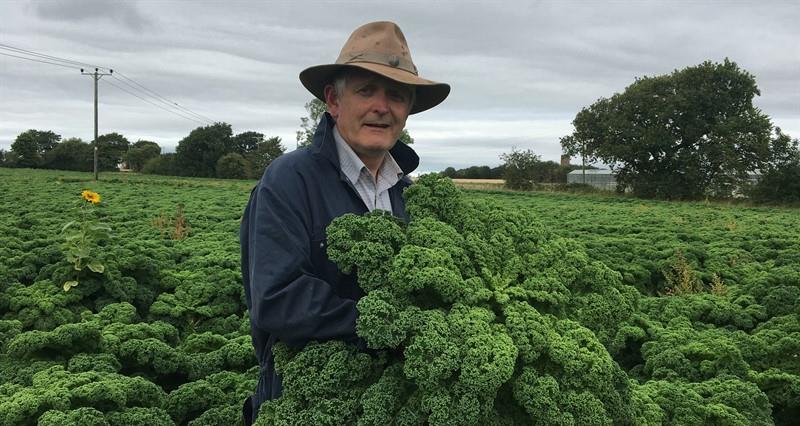
Photo: Chris Molyneux
Lancashire farmer Chris Molyneux has built a brand on brassicas that are as different as his farming regime. Sue Scott reports
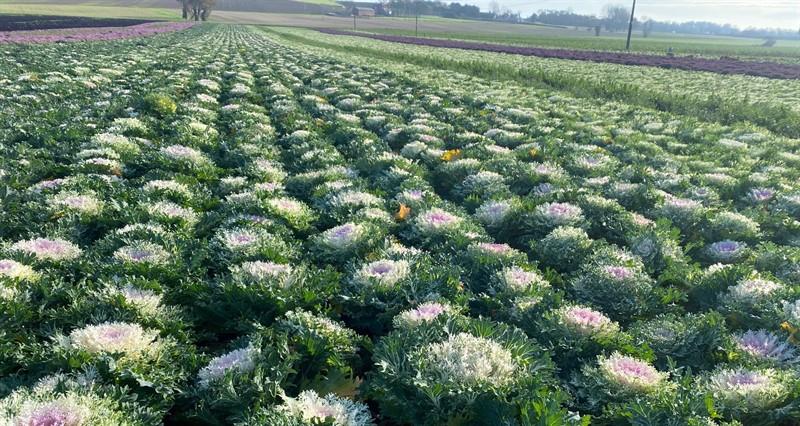
Molyneux Kale Company is by far the most colourful grower in West Lancashire, famous for painting the fields around Ormskirk with rainbow rows of brassicas, including black, white, green and purple kales, and red and candy-striped chard.
Its leaves are much sought-after by chefs to give an extra ‘pop’ to diners’ plates. This season, even orange and purple cauliflowers were added to the farm’s mix.
The family has been farming field-scale veg here for generations – principally spring greens, using farm-saved seed to develop their own early maturing and winter hardy varieties. Thanks initially to some industrious bees who cross-pollinated the beds with kale, they bred their own year-round supplies of that, too, for a very specific market niche.
“For the first 20 years, we hardly sold any kale for culinary use,” says Chris Molyneux. “We were supplying it as an alternative to parsley to dress the ice on fish stalls.
“Go into any Booths supermarket in the north of England today and you’ll still see it on their counter.”
But in the mid 2010s popular culture and kale collided. Beyoncé was seen wearing a blue sweatshirt with KALE written across the chest in a video for the song 7/11 that went viral. It coincided with celebrity chefs James Martin and Hugh Fearnley-Whittingstall promoting the leafy green as a ‘super-veg’. The then newly formed Molyneux Kale Company rode that wave.
“You couldn’t have asked for better advertising, and that really got us going,” says Chris. “2018 was peak kale. I had north east markets ringing me up to ask if we had any left.”
Marking a milestone
These days, though, it’s not so much what’s sitting on top of the farm’s 500 acres that’s drawing attention as what’s going on underneath them.
Earlier this year, Chris was named Soil Farmer of the Year in the annual competition run jointly run by the Farm Carbon Toolkit and Innovation for Agriculture.
The award marked a milestone in a regenerative farming journey that started decades before as a response to a common frustration on the black sands around Ormskirk.
“The thing about West Lancashire is the soils are not very deep – clay on top of sand about 12 inches underneath,” says Chris. “Traditionally, we ploughed in the autumn and then tried to get on the ground to plant in the spring. We have quite high rainfall here, and we were making a right mess of it – tractors getting stuck, all sorts of crazy stuff. And I was thinking ‘this doesn’t add up’.”
He recalled a conversation he’d had with a farmer during a work-cation in Australia, who’d dismissed ploughing as ‘so 19th century, mate’. Pumped with conventional training from his newly-acquired agricultural degree, it had stunned the young Molyneux at the time. But looking at the trenches carved out by smoke and steel back home, he wondered if there wasn’t some wisdom in it.
“So, I started experimenting with min til on the cereal break crops. We’d Round-up the field, subsoil it and then go straight in with the drill. This was in the late 80s/early 90s and people thought I was cracked. But I was getting better crops, even on the clay brows where we’d never got anything to grow before,” says Chris.
“Then one day I asked my wife, who’d been exercising her horse on pea stubble, to move on to spring barley stubbles so we could get into the field. But she said it was too hard. I knew I’d worked those fields the same day in the same perfect conditions – but she was right. When I did the ‘heel test’, my foot went into the pea stubble but not the barley.”
The comparison intrigued him, but he wouldn’t really understand the soil chemistry until years later, and when he did, it transformed his farm management.
The transition to regenerative agriculture has never been a crusade for Chris. Even if the radical changes he’s introduced since might look extreme to the average vegetable grower, each of them has been a solution to a particular problem that conventional farming just couldn’t fix.
Following years of experimenting with different kit, he now has a no-plough policy on 90% of the farm, strip tilling every field in 24in rows. He’s extended the traditional rotation to four or five years during which no cash crops are planted for two or even three of them. Instead, a leguminous cover mix is sown to rebuild soil structure, while the top is harvested for green manure (remember that pea field?). Even the tram lines are leafy lanes of vetch, clover and chicory.
In fact, Chris never wants to see bare earth again. “If it doesn’t have something growing in it, it’s not right,” he says – because his aim is to stimulate the natural chemistry of the soil and allow worms, not tractors, to do the heavy lifting.
Delivering measurable results
It’s been a continuous process of learning, analysis and observation which has led to something pragmatically positioned between an organic and conventional system. And it’s one that’s delivering measurable results.
Soil tests show high levels of retained potash – which historically the farm lost quickly through its free-draining sandy loam soils – thanks to the cover crop regime and monitored applications of green manure.
Chris has now started growing some of his kale without fertiliser and has seen both the quality and shelf life in those crops improve.
“We’re starting to understand how green manure can reduce the amount of conventional fertiliser we use across the rest of the acreage now,” says Chris. “By cutting the first cover crop at flowering (early June) you get loads of protein and nitrogen while still building fertility in the soil. If you take a second cut, you’re just making the clover work a bit harder.”
Weed control hasn’t been a problem, he says.
“When we top the cover crop what tends to happen is the weeds can’t survive and the clover takes over.
“Now that we use a biomulch (rotary tilling machine), which runs at about two to three inches deep, we have extra control and we can still use a bit of follow-up weedkiller if we need to.
“The important thing is, the cover crop is holding the soil down, which is great if you’re going through the winter with high rainfall,” he adds.
One of the biggest benefits from the changes he’s introduced is just being able to get on to the land when he needs to, says Chris. And in an area that experiences around 1,000ml of annual rainfall, that’s a competitive advantage for a veg grower.
“I would never be able to grow the acreage of kale I grow here conventionally because there wouldn’t be enough days in the year when I could get on to the crop,” says Chris. “It works both ways: when you have rainfall events, you can get on to the land sooner, but the soil also holds more water when it’s dry.”
There’s been a wider environmental payback, too.
“We’ve seen massive numbers of corn buntings, skylarks, partridges. I lost count of the lapwings,” says Chris. “I put that down to having cover crops in early – that and the worms.”
A bellwether for healthy soil, it’s their burrowing activity that has dramatically increased soil percolation across the farm, promoting stronger root structure, while reducing flooding, run off and leaching.
With an estimated 10t of worms to the acre, there are so many directly contributing to the profitability of Molyneux Kale Company, that Chris now jokes he’s a livestock farmer.
“When I saw worms powering up through the cracks in the tramlines behind my tractor tracks, I couldn’t believe it. I was just made up with it,” says Chris.
“You can do all the soil tests, talk about biometrics, but worms demonstrate you’re doing the right things: you’re really making your soil viable.”