The IPR suspension – what does it mean?
On 30 April, the European Commission announced that it would suspend IPR (Inward Processing Relief) on imports of raw sugar for onward processing. The suspension will last for 12 months and will only apply to raw sugar that is processed into refined sugar.
What does this mean? To remind readers, IPR allows sugar that it exported from the EU (either as such or in processed products) to generate a certificate, which permits an equivalent amount of sugar to be imported from outside the EU without paying duties. Prior to the decision this sugar could be imported as either raw or white sugar but, under the new rules, raw sugar imports will only be permitted if it is used directly (ie, it is not processed into refined).
To put this into context, in 2024/25, 587,000 tonnes of raw sugar was imported into the EU under the IPR scheme. This is roughly three quarters of all the raw sugar imported into the bloc in that year. The trend has continued in the first five months of 2025/26, with 371,000 tonnes of IPR raw sugar having already come in. Most IPR raw sugar originates from Brazil and is imported into deficit regions of southern EU.
The suspension of this trade will reduce the availability of raw sugar that can enter the EU duty-free and mean that refineries will have to buy their raw sugar from other sources. This, combined with an anticipated 8% drop in area in 2026/27, means that most analysts are expecting the market to need some imported sugar that attracts a duty of €98/tonne in order to meet demand.
This should help prices to recover further in 2026/27. But the question is whether prices will be high enough to cover the increased cost of growing and processing beet following the hikes in fuel, fertiliser and natural gas prices resulting from the US-Iran conflict.
We are just at the start of the period when a large proportion of EU sugar is sold for the coming year, but not much sugar reported to have been sold so far.
EU stocks remain high, but falling
A major challenge facing processors remains the amount of stock that will be carried into the 2026/27 crop year. The European Commission has reported that, at the end of March, stocks were around 0.7 million tonnes higher than they were at the same point last year.
The good news is that stocks do seem to be falling faster than in 2025; stocks were around one million tonnes higher year-on-year at the end of January.
Spot prices in the EU continue to firm; it is now difficult to buy sugar below €500/tonne ex-works, compared to €480 last month. Spot prices in the UK are reported to be around €540/tonne, unchanged from last month.
However, the price recovery does not appear to have come quickly enough for the 2025/26 MLB (market-linked bonus), with most of that sugar likely to have already been sold.
In the first half of 2025/26 (Oct 2025 – Mar 2026), the sales price reported by the European Commission for the Northwest EU averaged €511/tonne. Assuming a €60/tonne premium for the UK, that would imply prices achieved in the UK of around €570/tonne, close to the trigger value for the MLB of €575/tonne.
However, we know that the larger-than-expected EU crop kept the prices low during the period when most of the remaining sugar was sold. The market linked bonus will be calculated by an independent auditor in July.
World market – No.11 price holds up
The world sugar market continues to face a situation where Brazil needs to produce less than maximum sugar production in its 2026 harvest to bring global supply and demand into balance. As we have discussed before, for this to happen, prices need to trade close to ethanol. Ethanol prices have been falling as Brazil’s 2026 harvest has now started and new crop ethanol has reached the market.
However, No.11 sugar prices have been holding up, with October 2026 No.11 prices trading between 15-16 cents/lb in the first half of May. This, together with a weaker UK pound due to the uncertainty surrounding the Labour leadership, has kept the index-linked beet price above £25/tonne.
The situation in the Gulf remains an important part of the support for prices. While the military conflict has calmed down, the Strait of Hormuz remains closed; if this does not change, oil prices could spike even higher.
After months of keeping the gasoline price unchanged in Brazil, Petrobras has indicated that the producer price of gasoline price will soon be increased. However, at the same time, the government will provide a direct subsidy to gasoline producers and importers, which might offset this.
With the presidential election looming in October, it is clear the Brazilian government wants to keep fuel prices low for consumers. This continues to limit the upside for sugar.
But, looking ahead, the market is increasingly aware of future supply risks. El Niño, which can be negative for sugar production in both Brazil and Asia is a concern, and the impact on global production can be big if the event is strong.
In its latest report, the NOAA (National Oceanic and Atmospheric Administration) indicated that there was an 82% chance of an El Niño weather pattern developing between May-July and a 96% chance by December. We will know more about the strength of the event in the summer (El Niño events normally peak between October and February). If we add reduced fertiliser application to this, the world market outlook could start to look much more positive for 2027, and futures prices for next year have already started to move up.
UK situation – alternative crop prices improve
Finally, a word on the UK situation. Last month, we looked at the increased risk posed by aphids this year. Since then, relatively cool weather has slowed their development. However, the BBRO has flagged that myzus persicae are the dominant species being found in their traps, which increases the potential risk of Virus Yellow infection as and when the weather warms. The cool, dry weather also means that emergence has been patchy, leaving some beet in a vulnerable position.
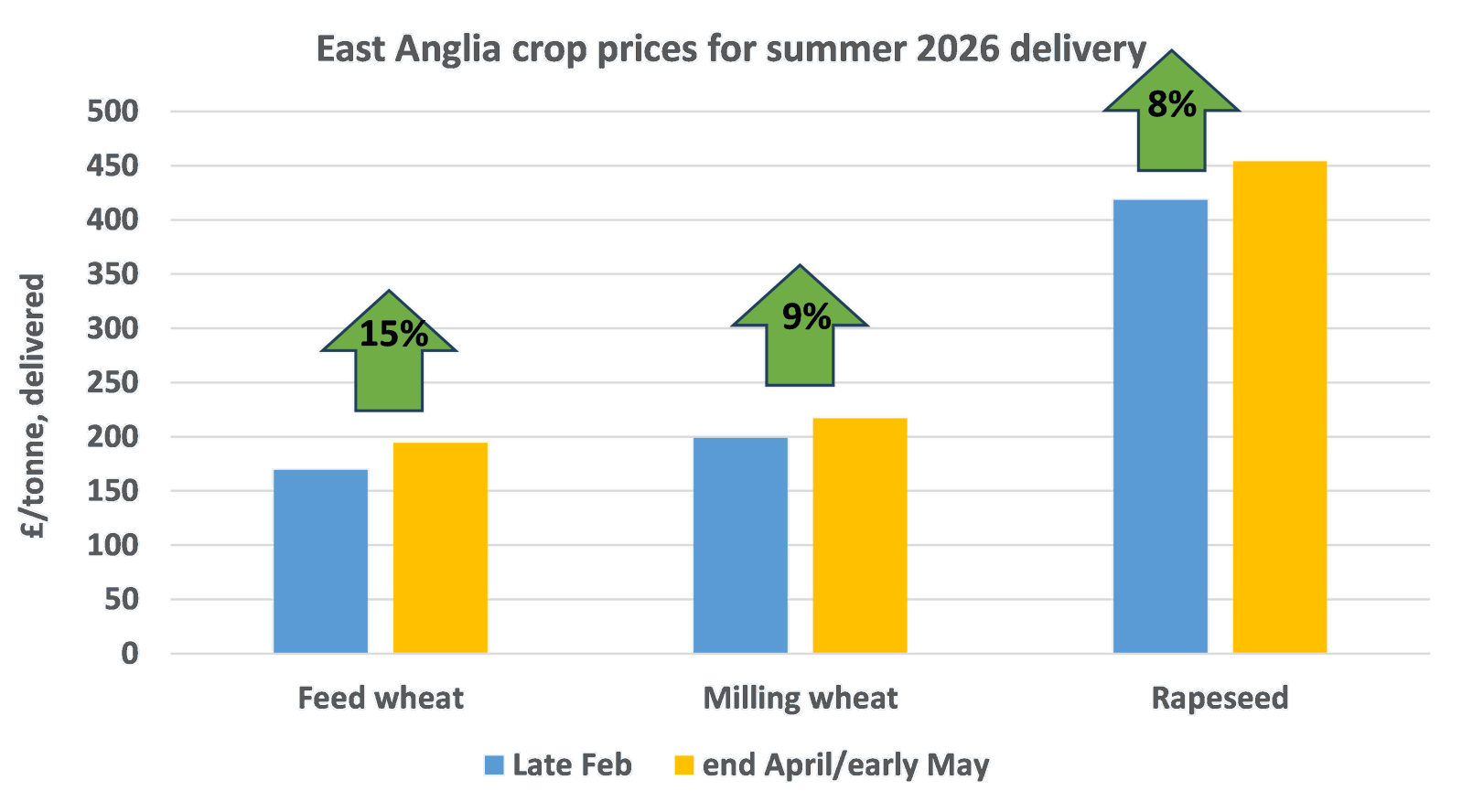
Growers also face the challenge of rising costs of production. We estimate that the cost of growing beet has increased by around 10% since before the conflict began, ie, more than £3/tonne. While the cost of growing other crops has also risen, the prices of these crops has been rising too.
The diagram below shows that rapeseed prices for summer 2026 are around 8% higher than before the US-Iran conflict, and feed wheat is around 15% higher. This highlights that if farmers are to continue to grow beet in both the UK and the EU, the higher cost of growing the crop will need to be accounted for.
You can read more about the impact of the Middle East conflict on growers in NFU Sugar Board Chair Kit Papworth’s article, where he reflects on the combined pressure of rising input prices and high Virus Yellows pressure, and what it means as we head into 2027/28 beet price negotiations.
A trader’s view

NFU Sugar Board appointee Paul Harper
Paul has spent his entire career in commodities and has been in sugar since 1976. He joined C Czarnikow in 1973 working in their London, New York and Singapore offices. Paul has a huge amount of consultancy experience, having consulted for a hedge fund, major bank and a large trade house in sugar during that time.
The October No.11 prices has continued to trade in the recent range since our last report. The speculative element has reduced its short position to under five million tonnes and is helping to keep the market steady.
Producer selling continues when the market rises above 15 cents/lb in the nearby position and for the moment there is little change in fundamentals to encourage any change of attitude.
Uncertainty in the Middle East is keeping oil elevated, which in turn underpins the sugar price. El Niño, which is still expected to be of some significance further forward, is also giving support to the market at the lower levels because it could affect sugar production in Brazil.
While the market remains in surplus for 2026/27, the number is relatively small and this could change quickly should the weather situation deteriorate at any time in important growing regions.
It is likely that, for now, the market will continue range-bound until something changes to encourage traders one way or the other to build a position.