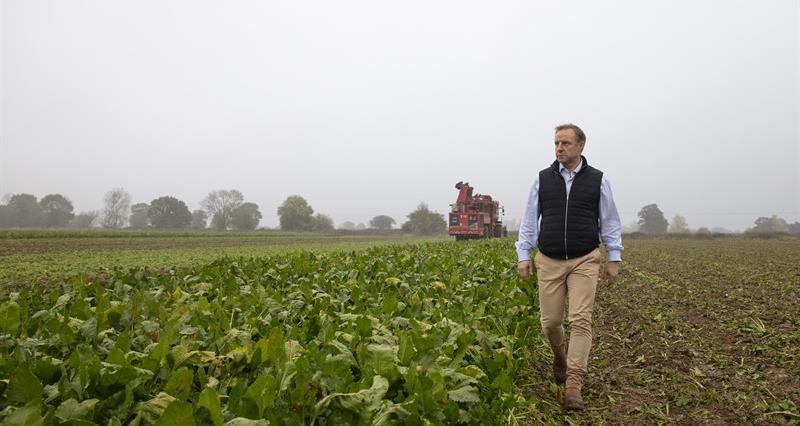
As NFU Combinable Crops Chair Jamie Burrows pointed out last week, these really are extraordinary times for our sector.
As beet growers, we’re exposed to the same challenges facing arable enterprises the length and breadth of the country in relation to fertiliser and fuel.
But we’re also uniquely exposed, as we head into negotiations for the price and terms of the 2027/28 beet contract, to a world sugar market in surplus.
Challenging negotiation ahead
“I would urge it [the government] to be prepared to take all necessary steps to support farming and food production at this critical time.”
NFU Sugar Board Chair Kit Papworth
The conflict in the Middle East has sent costs of production skyrocketing at a time when growers are already seriously considering the profitability of sugar beet.
Even prior to the conflict, growers collectively took up the option to put three-quarters of one million tonnes of sugar beet on ‘contract holiday’ with British Sugar this year – opting not to grow in 2026 while retaining the right to in 2027 in the hope that margins in the crop may improve.
These are growers for whom beet is a critical part of the rotation, but who simply can’t afford to grow at current prices.
Add into the equation the current situation with aphid numbers and Virus Yellows pressure and growers are facing an even tighter squeeze on already wafer-thin margins.
While the prices of many commodities, including wheat and OSR, have strengthened since the conflict began, the same is not true for all sectors and sugar market conditions remain challenging. As we head into what will unquestionably be a very difficult negotiation, with costs of production hitting new ceilings, something has got to give.
What we’re doing on inputs
On fertiliser and fuel, I’m extremely concerned not only about price but also availability.
I recognise that some growers will not have purchased fertiliser ahead for 2026 prior to the beginning of the conflict, and I’m worried as I look forward to 2027.
We’ve already done all we can within our business to optimise nutrient use efficiency and we’ve cut application rates back further this year owing to the ongoing drought, but there’s only so far you can go.
We absolutely need greater transparency to enable effective decision-making going forward and there should be a role for Defra in supporting this. Suspension of import duties on fertiliser would help tackle the immediate inflationary pressure on farm.
Red diesel and road diesel prices up c.30% and c.40% respectively are only the beginning of my concerns in relation to fuel.
I’m aware of many growers increasingly having to order fuel ‘price unseen’ and, while I commend purchasing groups for doing a good job at a difficult time, this is simply crippling in terms of on-farm planning.
Within our business we’ve begun to look at some of the hedging tools available through some of the purchasing groups in order to capitalise on lower prices as and when they occur, but the opportunities to do so have been limited so far.
Concerns about future availability
Looking forward, I’m particularly concerned about availability. As we head towards harvest and then onto the sugar beet campaign we’re going to need fuel for tractors, lorries, harvesters, dryers, cleaner loaders and everything else besides.
I’ve already heard of farms borrowing supplies from neighbours in order to keep the wheels rolling.
In the words of the government, ‘food security is national security’. I would urge it to be prepared to take all necessary steps to support farming and food production at this critical time.