The Beet Brief: Weather and speculation drive a rally in the global market


James Thompson
NFU Senior Commercial and Market Analyst
In this month’s beet brief, NFU Senior Commercial and Market Analyst James Thompson explores the recent rally in sugar markets, the reality of yield reductions across the UK and Europe, and whether the market is fully accounting for the losses to come as it turns its focus to production outcomes.
Highlights:
- Sugar prices have rallied sharply as markets respond to worsening crop prospects and tighter global market sentiment.
- EU sugar beet yield forecasts have been cut again following prolonged heat and drought across western and central Europe.
- European sugar prices gradually firm as buyers and sellers assess the implications of a smaller 2026/27 crop.
World market developments: Index-linked beet price benefits from a late rally
Sugar markets have undergone a significant shift over the past month, with October 2026 No.11 futures rising from the mid-14c/lb range to a high of 18.6c/lb. This rally pushed the index-linked beet price briefly over £33/tonne before closing on Friday at £31.18/tonne. For most of the final two weeks of the pricing window, growers had the opportunity to secure a price of over £30/tonne despite the price beginning August below £25/tonne.
At first glance, this price strength appears difficult to reconcile with the underlying fundamentals. Brazil continues to report robust cane availability, cumulative crushing remains ahead of last season, and mills have steadily increased the proportion of cane allocated to sugar production as sugar prices have improved.
However, weather concerns have intensified across India, Thailand and Europe, while India’s decision to allow one million tonnes of duty-free raw sugar imports has reinforced concerns regarding the country’s domestic balance.
Speculative funds have also played an important role in the recent rally. Having spent much of the year holding substantial short positions, weather risks have encouraged fund managers to rapidly cover bearish positions. Speculators now have a net long position in the sugar market for the first time in two years. This shift in sentiment has amplified the move higher in prices.
EU/UK crop outlook: From weather risk to supply reality
The dominant story for Europe is no longer weather risk. It is anticipated yield loss.
The latest EU Commission (JRC MARS) report reduced the EU sugar beet yield forecast by 5% against the 5-year average and down on the previous forecast in late July. The crop has continued to deteriorate, not recover. The report highlights widespread impacts from prolonged heat and severe water deficits across western and central Europe.
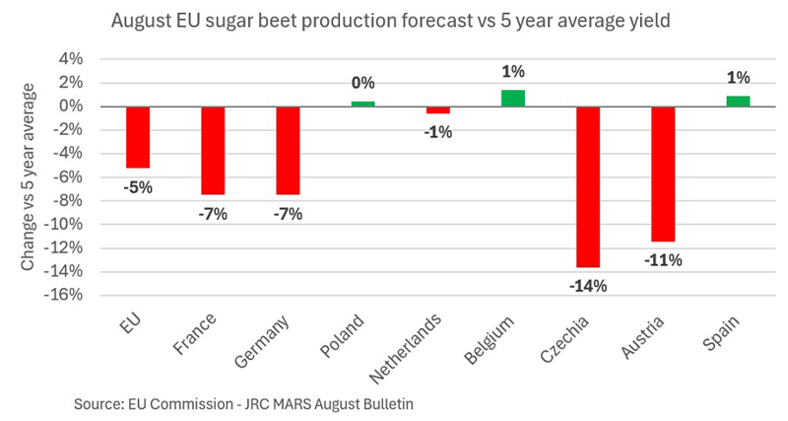
Particularly concerning is the consistency of the story across major producing regions. France has experienced exceptional drought conditions, with the French sugar beet sector itself (AIBS) warning of yield reductions of more than 20% against the 5-year average due to very low root weights and poor leaf development. Germany, the Benelux countries, Czechia, Austria and Slovakia are all also facing reduced yield prospects.
The latest EU sugar balance sheet estimates for 2026/27 project that EU sugar production will be down to only 13.4 million tonnes, compared to the 14.1 million tonnes in the previous estimate. This compares to around 16.6 million tonnes in 2025/26, an almost 20% reduction.
The UK crop has faced particularly extreme conditions and is likely to face similarly significant yield losses. For growers, the key takeaway is that significant yield reductions are no longer theoretical.
EU/UK market developments: Higher prices begin to emerge
Recent weeks have seen a strengthening of European sugar prices.
Market reports indicate prices are moving higher across several regions as buyers return to the market and crop concerns intensify. The spot price for North-West European sugar has been assessed at around €550/t ex-works, while delivered prices in the UK have reached approximately €580/t. There are also reports of significantly higher offers for new crop sugar in some deficit regions.
These prices may not fully reflect the much-reduced crop estimates, in part because of the role of stocks, which in the EU and the UK are estimated to finish the 25/26 season at approximately 3.3 million tonnes. This is very high by historical standards and driven recently by a surge in imports in June as importers frontloaded IPR (Inward Processing Relief) imports ahead of the suspension of IPR raw sugar imports.
Stocks will thus continue to provide a buffer in the near term. However, markets are increasingly looking beyond inventory levels and focusing on the scale of yield losses anticipated in the upcoming campaign.
Looking ahead
The focus for the next month will increasingly move from weather to harvest results.
As lifting begins across Europe, the market will gain clearer insight into the extent of yield losses and whether current production estimates prove accurate.
After spending much of the summer debating weather risk, the market is now entering a period where production outcomes will begin to provide answers.
A trader’s view
Courtesy of Paul Harper, NFU Sugar board appointee and sugar trader.

The No.11 sugar price finally broke out of the range (13c/lb to 15c/lb) that it had been trading in for some months. Started by the speculative community covering their short positions and encouraged by global weather conditions causing problems for processors, the market quickly gathered momentum and a sharp rise ensued.
In the No.11, having been more than 6 million tonnes short, the last reported position held by the speculators was around 5 million tonnes long!
As mentioned before, weather, seriously now being affected by El Nino, is causing major production and shipping problems for sugar-producing countries. Delays in shipments from Brazil, coupled with a lack of rain in India and Europe, mean global supply/demand deficit forecasts are rising as production numbers are being reduced.
The market has become a lot more volatile and is likely to remain so in the near future. The white sugar market in particular has seen some large price fluctuations with the white sugar premium (the $/tonne difference between raw and white sugar prices) moving down by more than $20/tonne at one point. Raw sugar prices, having traded to a high of 19.62c/lb in the March 27 position, closed pre-weekend more than 1c/lb lower. This remains well above the highs of the previous trading range.
The beet price having expired for pricing on 28 August for the current crop, closed at £31.18/tonne having traded to a high point of £33.18/tonne.
The Beet Brief from NFU Sugar is prepared for UK sugar beet growers only. While every reasonable effort has been made to ensure the accuracy of the information and content provided in this document at the time of publishing, no representation is made as to its correctness or completeness. The NFU and the author do not accept liability arising from any inaccuracies, be they errors or omissions, contained within this document. This document is intended for general information only and nothing within it constitutes advice. It is strongly recommended that you seek independent professional advice before making any commercial decisions.