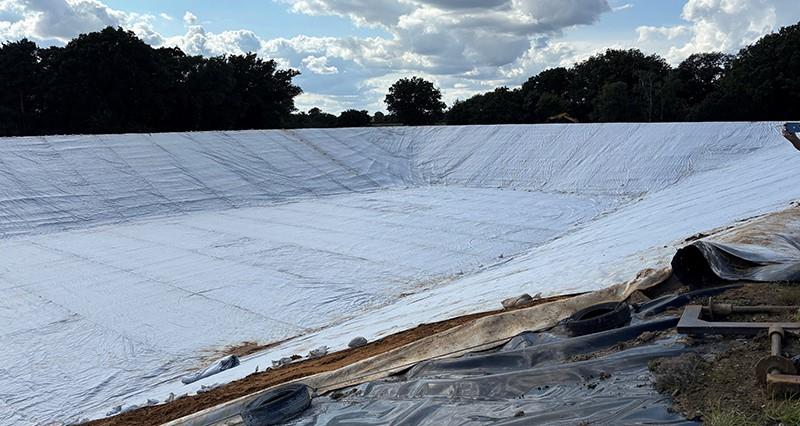
The development of more and higher capacity on-farm reservoirs is seen as a key requirement for many farm businesses in order to make food production more sustainable under conditions of drought or reduced water availability.
As we have seen with recent drought conditions, these will include areas and businesses that have not traditionally considered water storage as a necessary part of building resilience into their operation.
Development of an on-farm reservoir will require the necessary consent from the LPA (Local Planning Authority) and an abstraction licence from the EA (Environment Agency) if it is being supplied with more than 20 m3 of water per day from ground or surface water sources.
Guidance for developing an on-farm reservoir has been developed, with case studies from the East of England.
Funding
Previously, the construction of on-farm reservoirs has been supported by two rounds of the WMG (Water Management Grant), launched 2021 and 2023 respectively, both worth up to £10m.
The minimum grant value was £35k and the maximum was £500k per applicant business, per round of funding. Grant funding only contributed to 40% of the eligible costs.
The WMG is expected to reopen in the Autumn of 2026 with up to £15m available to help farmers build on-farm reservoirs.
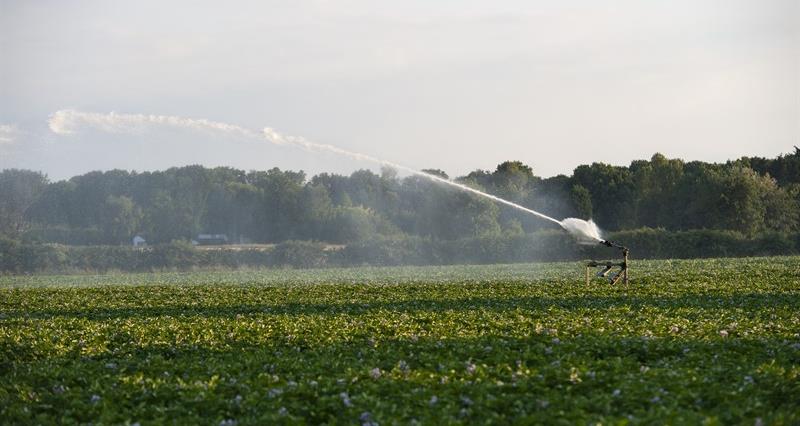
The scheme will focus on supporting water storage for crop irrigation, helping the horticulture and arable sectors adapt to climate change and improve resilience to drought.
If demand exceeds the funding available, the Government have said they will keep the budget under review and consider providing additional funding.
The EA has also funded LRO (Local Resource Options) studies in 2024 and 2025 that bring groups of farmers together to assess what options are open to them to deliver water in the future and explored what challenges they face.
For farm businesses in Cambridgeshire there is, in addition, a sperate Agricultural Water Resilience Grant scheme supporting between £2,00 and £50,000 of eligible costs funded by the Ministry of Housing, Communities and Local Government (MHCLG) via Cambridgeshire County Council.
Planning
Generally, farm reservoirs are covered under permitted development rights, however, under the Habitats Directive, reservoirs exceeding 1ha in size, or those significantly impacting SACs (Special Areas of Conservation) or SPAs (Special Protection Areas), will require an EIA (Environmental Impact Assessment) to ensure they don't negatively affect protected habitats or species. This can override permitted development and trigger a full planning process.
A prior notification submission will be required in all cases and LPAs (local planning authorities) may require a subsequent prior approval submission. If an EIA is triggered, a 'screening opinion from the LPA will need to be sought before submission of the prior notification.
There may need to be an archaeology survey with or without an EIA, which can add significant costs and delays to the planning process.
A mineral extraction licence is also often required for the development of a reservoir. This is because it is treated as a small quarry.
Furthermore, the waste of the excavation is treated as industrial waste, leading to expensive demonstrable recycling or disposal. LPAs can negatively view any on-site disposal for landscape impact purposes and surface water contamination. It is important to note that the waste disposable element can add significant cost to what should be quite a straightforward process.
LPAs also vary in their capacity to undertake these assessments with some offering in-house services and others requiring the applicant to engage with organisations such as Natural England separately.
We are expecting the Government response to the National Planning Policy Framework consultation, where they have stated they will make it clear that local authorities should support the development of agricultural infrastructure, including reservoirs.
In September, the Ministry of Housing, Communities and Local Government (MHCLG) will publish updated planning guidance for on-farm reservoirs to give farmers more clarity and confidence when investing in water resilience.
Defra and MHCLG have committed to working with farmers and industry representatives, including the NFU and CLA, to review evidence on the effectiveness of current permitted development rights (PDRs) for on-farm reservoirs.
Abstraction licencing
Abstraction licencing is required if a reservoir is to be filled with water taken from the surface or groundwater, or if the reservoir is clay-lined and holds water at or below the water table, at a rate greater than 20 m3 per day.
The EA produces abstraction licencing strategies for all catchments that indicate the likelihood of obtaining a licence to take water from the environment. There are significant abstraction pressures nationally that are more acute in certain areas making obtaining a licence less likely.
Application details for an abstraction licence can be found at: GOV.UK | Apply for a water abstraction or impounding licence.
‘From September 2026, the EA has committed to simplifying its application process for long-duration abstraction licences for reservoirs to support farmers and other abstractors to apply for licences that better enable long-term investment in water and help farmers secure long-term finance.’
Reservoir safety
Reservoir safety is currently under review with the potential for more reservoirs to become covered by regulation. Currently, reservoirs less than 25,000 m3 do not have to be registered but, whether you need to register your reservoir or not, you must follow HSE (Health and Safety Executive) regulations and local council building regulations.
Details of the requirements for those reservoirs over 25,000 m3 can be found at: GOV.UK | Reservoirs: owner and operator requirements.