Growing up on my parents’ farm (mainly dairy, but with beef and sheep) and working there full time until I was 24, I had no idea that this would be the route I would take. The dairy farm was good, but I felt I had reached the end of my ability there and yearned for something new. We were considering trying to get a farm tenancy somewhere to try to regeneratively farm with a suckler herd and sheep.
However, we started thinking that we have this opportunity where we have the time and finances to take things slow and really explore what we want to do before jumping head-first into the next big project.
“Anything I can learn that may provide another string to my bow is much appreciated... My experience as a butcher has improved my ability to farm and raise livestock.”
Ed Harrison, former SYFAP
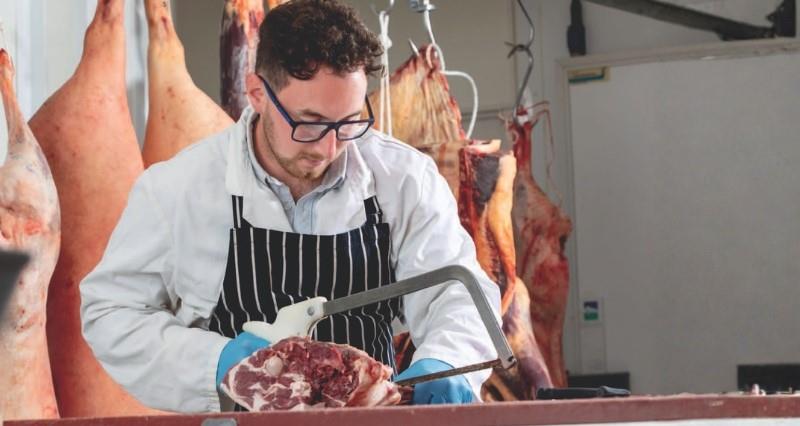
As we were contemplating which direction to start looking, an opportunity came up at a local on-farm butchery to learn the skill. It was something different and would increase my knowledge, so I thought I would have a go.
Becoming a better livestock farmer
Although it wasn’t a path I had anticipated taking, going into butchery has been a fantastic way for me to increase my opportunities, knowledge, and skills. The knowledge I gained beforehand from the farm, of the Simmental/Fleckvieh cross cows and Easycare sheep meant that I had a wide base to increase from.
Anything I can learn that may provide another string to my bow is much appreciated. I have always and will always want to farm, but now with my experience from the butchery side under my belt I hope to become an even better farmer.
My experience as a butcher has improved my ability to farm and raise livestock. We now have a small farm where we run all our cows and sheep regeneratively.
Observing the carcasses and animals as they pass through the butchery, representing various breeds, systems, and degrees of finish, as well as conversing with the farmers, has improved my understanding of animal finishing and provided me with ideas for utilising various systems.
Being able to butcher is one of the most ancient and valuable skills. When it comes to cutting and crushing meat, we have come a long way since our early human ancestors used stone tools! It’s also fascinating to observe how other countries prepare their carcasses and experiment with various styles and cuts as there are so many distinct methods and styles used throughout the world.
Finding a balance between quality and quantity
Our regenerative journey benefits from butchery because it allows us to tell each animal’s story in its entirety to the customer. Farming in a way that improves natural biological diversity and improves livestock health and welfare includes what happens to the animals after they have left the farm. This includes the journey to the abattoir and to the butchery and then to the end consumer. We need to be looking at the entire journey not just the farm to wagon.
When I was only on the farm, I had a general understanding of the differences in meat quality between grass-fed and grain-fed cattle, as well as how some breeds affect quality. However, all of the information I had was from advertisements, so it was biased. I had seen too few comparisons between breeds to be able to reliably give an opinion.
However, now that I have worked with a wide range of carcass breeds I am able to say that it most certainly depends on the breed, but equally the management and what the animal is fed. It takes all of the above to be correct to have the best quality meat.
You can have a massive carcass from a grain-fed continental breed that will produce hundreds of kilos worth of meat, but will it have the flavour? Probably not. You can have a small native British breed being grass fed all its life that will produce an amazing flavour of meat, but will there be enough to feed the village? Probably not.
It is entirely up to the farmer which one they want to aim for: is it the quality or is it the quantity? And likewise it’s entirely up to the consumer which one they want to buy.
However, now that I have worked with a wide range of carcass breeds I am able to say that it most certainly depends on the breed, but equally the management and what the animal is fed. It takes all of the above to be correct to have the best quality meat.
You can have a massive carcass from a grain-fed continental breed that will produce hundreds of kilos worth of meat, but will it have the flavour? Probably not. You can have a small native British breed being grass fed all its life that will produce an amazing flavour of meat, but will there be enough to feed the village? Probably not.
It is entirely up to the farmer which one they want to aim for: is it the quality or is it the quantity? And likewise it’s entirely up to the consumer which one they want to buy.
For me, I’m aiming to go down the middle with regenerative farming, moving native cows onto new, mixed-species pasture every day means they can get the most densely nutrient packed grasses and legumes and also be getting the necessary quantity of forage to be able to put on the weight and have a bigger carcass at the end.
Putting British breeds back on the menu
The Wagyu breeds are known for the fat marbling in their meat, which has led to its rapid rise in popularity; however, most native British breeds do as well, and these may be less well known to the public due to the reputation and advertisement of Wagyu overshadowing these traditional native breeds such as the Galloway, Hereford and Shorthorn.
However, as above, it doesn’t just take the breed to make the meat. A mismanaged Wagyu could have less marbling than a well-managed continental breed.
When going to a restaurant now, how often is it seen that it states ‘Wagyu steak’ on the menu while other meat is just ‘beef’ or ‘lamb’. Personally, I feel like the breed of all the meat in a restaurant should be labelled as such, to increase the traceability and provide the customers with the correct information to make informed decisions next time they are in a shop. If they had an absolutely amazing meat dish that’s labelled with the breed, maybe next time they are shopping they might buy that same breed of meat.
I am very lucky in the fact that I can now make informed decisions on how to create the meat that I want. Anyone wanting to get into butchery should approach their local butcher and ask if they could do any work experience. Farmers may also be able to help you with a connection, and your local farm shop is also a good point to start.
Even if it’s not a career path you fancy, I strongly believe all farmers should go to a butcher’s workshop day and see it for themselves, and then decide what they want to get from their cows or sheep. This may mean changing breed, management or feed. Who knows, it may even relight their passion for livestock farming!