Looking after soil isn’t just good for the environment. Knowing what is happening beneath your grass can help make better use of nutrients, avoid unnecessary inputs and support a productive, resilient farming system.
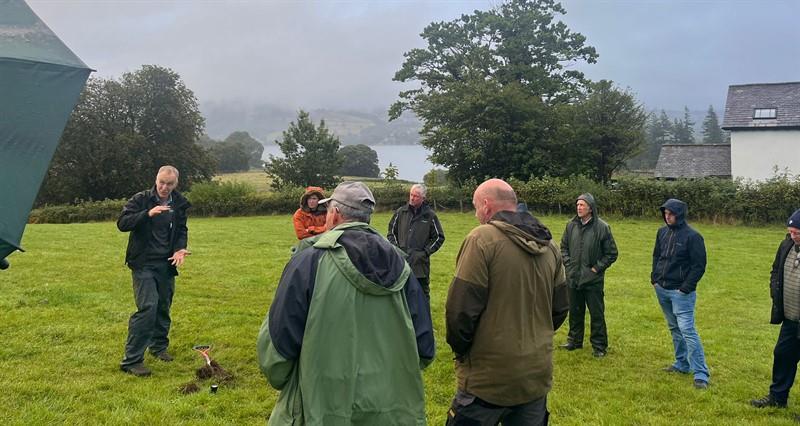
That was the message from a farmer event at High Wray Farm, near Hawkshead, on Wednesday 2 September. Chris and Sheila Briggs hosted other farmers and land managers from the catchment to consider what they could do on their farms to improve soil health.
The event brought local farmers together to talk about something every grassland business relies on, but which can sometimes be overlooked: the soil beneath the sward.
Led by James Bretherton from Agscope, the discussion focused firmly on practical management and the farm business. His starting point was simple. Growing grass has a value, but making and taking a crop also has a cost. Understanding those costs and making the best use of what is already available in the soil, can help a business decide where spending money on inputs will genuinely pay.
Start with the soil test
One of the simplest tools available to farmers is also one of the most useful ones: soil testing.
Knowing the pH and nutrient status of individual fields provides a much better basis for making decisions. For phosphorus in particular, the aim isn’t simply to add more. It's about knowing what you’ve already got and are creating the right soil conditions for the growing crop to make use of it.
James discussed the importance of keeping soil phosphorus indices at an appropriate level and getting pH right. “Where lime is required, farmers also need to consider the product being used adding that calcium or magnesium containing granulated lime are available.”
Ultimately, if you’ve already got phosphorus in the soil, you want the grass to use it rather than lose it. That’s good for the farm’s bottom line and, in the Windermere catchment, has an additional benefit. Keeping phosphorus in the field and reducing the risk of it leaving the farm through runoff or soil loss can help reduce the amount finding its way into watercourses and, ultimately, Windermere.
Don't forget the grass
The conversation wasn’t only about what farmers put onto the soil. How grass is grazed can be just as important.
James highlighted the value of giving grass enough time to recover between grazing. Rest gives the plant an opportunity to rebuild leaf and root growth before it is grazed again.
For farmers, the practical message is to look at the whole system. Healthy grass needs healthy roots, and healthy roots need soil that is working well. Getting the basics right, including pH, nutrient balance, soil condition and grazing management, can help make better use of the nutrients already in the soil and any inputs that are bought onto the farm.
What works for your farm?
There was also a useful reminder that good soil management doesn’t mean every farmer should be chasing maximum grass production.
Host farmer Chris Briggs talked about the system at High Wray Farm and his move into Countryside Stewardship Higher Tier. This will see the business move towards a more extensive system, including reducing cattle numbers.
That means Chris may not need to push every acre for maximum grass growth. Instead, soil and grassland management need to fit the stocking levels, environmental objectives and economics of his own business.
And that’s an important point. There isn’t one single answer that will suit every farm, or even every field on the same farm.
A field being managed for silage has different demands from permanent pasture managed more extensively. What matters is understanding what you’ve got and matching inputs and management to what you actually need.
Keeping a valuable nutrient on farm
The soil health work forms part of the wider Love Windermere Partnership Action Plan.
For farmers, however, the starting point needn’t be about doing something for Windermere. It can start with doing something that makes sense for the farm.
Phosphorus is a valuable nutrient. If it's already present in the soil, making it available to a growing crop has a value. If it leaves the field, that value has been lost to the business.
So the question is a practical one: are you getting the best from what you’ve already got? A soil test, a look at pH and nutrient levels, and a bit of thought about grazing and grass recovery can provide a useful starting point.
There will never be a single soil management recipe for farms across the Windermere catchment. But keeping soils functioning, nutrients available to the crop and phosphorus where farmers need it can deliver benefits on both sides of the farm gate.
Five things to think about on your farm
• Know your numbers: use soil testing to understand pH and nutrient levels rather than guessing.
• Get pH right: it can make a real difference to how effectively the crop uses the nutrients already present.
• Don't apply what you don't need: understand soil phosphorus levels before deciding what additional nutrients are required.
• Give grass time to recover: think about the rest period between grazing as well as what happens on grazing day.
• Manage for your system: maximum grass production isn't the objective on every farm or every field. Focus on what works for your business.
Looking after soil is about making better use of a farm's existing resources.
If that also helps keep valuable phosphorus in the field and out of Windermere, it's a win for both the farm and the catchment!
Find out more about the Love Windermere partnership