
EU/UK beet crop outlook: August rainfall now critical
The 2026/27 crop has entered its most important phase.
Following a dry spring and prolonged periods of high temperatures across western Europe, attention is increasingly focused on soil moisture rather than temperature. While sugar beet remains relatively resilient compared with many arable crops, sustained moisture deficits during the bulking period will be limiting yield prospects.
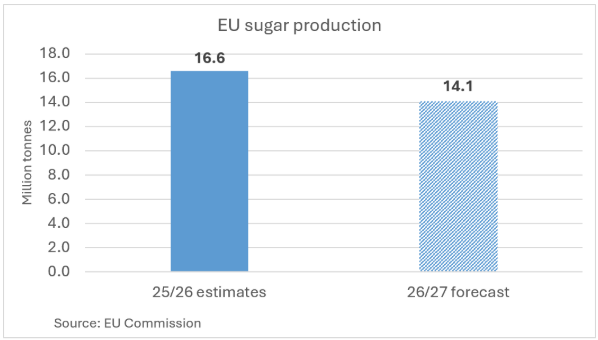
The latest European outlook points to production falling sharply from the exceptional levels achieved last season, reflecting both lower area and lower expected yields. However, there is growing concern that the current yield forecast may still prove optimistic if meaningful rainfall fails to materialise.
For UK growers, conditions remain variable. Some crops have benefitted from timely rainfall but most are increasingly reliant on rain arriving during August. The next few weeks will play a major role in determining final yield.
EU/UK market developments: From stocks to supply concerns
The European market entered 2026 with one major challenge: high stocks following a stronger than anticipated crop.
Those stocks have not disappeared and continue to provide a buffer against supply shocks. However, market attention is beginning to shift away from inventories and towards production prospects for the coming campaign.
Reduced beet area across much of Europe already points towards lower output in 2026/27. If yields also disappoint, the market balance could tighten more quickly than many expected earlier in the year. Taken alongside the suspension of imports of IPR raw sugar (see May Beet brief), discussions are increasingly focusing on the possibility that duty-paying imports may be needed to meet demand in 2026/27.
What does this mean for prices?
Weather has become increasingly important.
Should August bring meaningful rainfall to Europe and improved conditions in other growing regions, current production forecasts may largely be realised. However, if dryness persists, markets may begin to reassess both European and global supply prospects. Analysts are becoming increasingly confident that imports of sugar attracting a duty of €98/tonne will be needed to supply the EU+UK market.
Trading activity has reportedly slowed as buyers and sellers wait for greater clarity on crop prospects. Current prices reflect caution rather than outright concern, with spot prices in the UK reported to be around €560/tonne, down on last month despite the continued weather concerns
In the near term, imports may be placing pressure on prices, with the EU reporting more than 200,000 tonnes imported in May alone. As a result, EU stocks are estimated to be around 12% higher than at the same point last year.
World market developments: A market of two halves
The global sugar market remains characterised by a contrast between comfortable raw sugar supplies and a much tighter white sugar market.
On the raw sugar side, Brazil continues to provide a significant cushion to the global supply-demand balance. The Centre-South region’s harvest remains ahead of last season in terms of cane crushed, despite weather-related interruptions during June and July. Although mills have continued to favour ethanol production, the sheer volume of cane available has allowed both sugar and ethanol production to remain substantial.
This continues to limit the market’s ability to sustain a rally with October 2026 No.11 price trading between 14-15c/lb in second half of July. While weather concerns have encouraged speculative funds to reduce some of their bearish positions, the underlying picture for raw sugar remains one of adequate supply. This is reflected in the index linked beet price which has been kept below £25 in recent weeks.
The situation is different in white sugar. The white premium has remained above historical norms, supported by expectations of lower production in several key regions, including the Gulf, and concerns around refined sugar availability. As a result, the market increasingly feels like a story of two halves: ample raw sugar supplies alongside a more bullish outlook for white sugar.
Looking ahead
The focus for August will be Europe.
While developments in Brazil, India and Thailand remain important, the key question for the European market is whether crops can achieve current yield expectations.
After spending much of the year discussing stocks, imports and Brazil, attention is now on the crop growing in the field. The answer to that question is likely to play a major role in determining market sentiment as harvest approaches.
A trader’s view
Courtesy of Paul Harper, NFU Sugar Board appointee and sugar trader.

NFU Sugar Board appointee Paul Harper
Paul has spent his entire career in commodities and has been in sugar since 1976. He joined C Czarnikow in 1973 working in their London, New York and Singapore offices. Paul has a huge amount of consultancy experience, having consulted for a hedge fund, major bank and a large trade house in sugar during that time.
The market would appear incapable of trading outside of the range we have seen for the past few months.
When the speculators sell the market moves down and when they stop it rebounds until reaching levels that the producers are happy to hedge.
The weather continues to be unpredictable and this is, for the time being, giving the market support at the lower end of the range. Northern Europe is lacking rain and in Brazil there continues to be disruption in harvesting because of rain.
The white premium continues to hold firm with October trading around $140/tonne over the No. 11 raw sugar contract.
The most recent report shows that speculators have again increased their short position and now stand in excess of 6 million tonnes short. At the time of writing the market is trading towards the top end of the range and it will be interesting to see if a break of the recent highs would encourage them to cover.
The beet price on the index-linked contract currently stands at £24.90/tonne having traded to a low of £23/tonne over the period