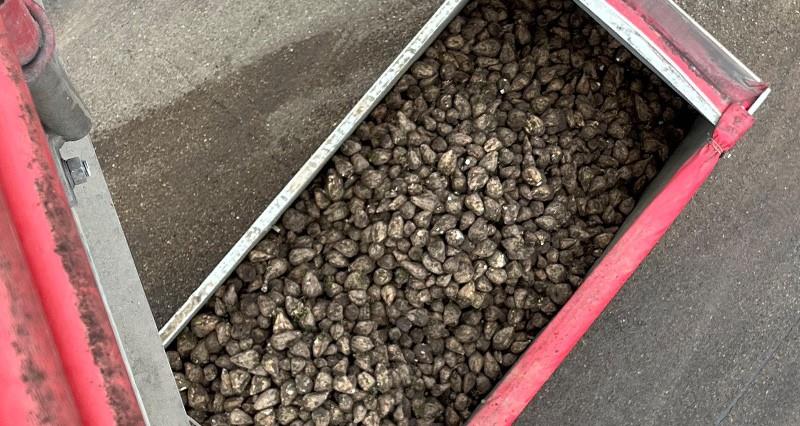
We have broken down the sample and tarehouse procedure into 11 steps to help you understand what happens to your sugar beet sample and how your sample results are determined.
If you do have any further questions, please call our Beet Reception Programme Manager Sarah Smith on 07968 321 792.
Step 1
- Samples are taken by the ABS (automatic beet sampling) equipment every day, at each of the British Sugar sites, and loaded into cages.
- The cages are labelled with the sampling factory, dated and time stamped with the time the first sample was loaded.
- Once beet intake closes the samples are transported to the Central Tarehouse at Wissington (except Wissington’s cages).
- On arrival, the cages are unloaded and sorted into time stamp order, starting with the earliest, to keep within the 24-hour testing time limit.
- The samples are removed from the cages and placed onto a conveyor.
Step 2
- Samples make their way into the tarehouse to the ‘dirty scale’ where they will be weighed as a whole, including the dirt, clods and stones etc, to obtain the DW (dirty weight) of the sample.
Step 3 – sample preparation
- The sample bucket is emptied into the scale tray.
- The stub card is removed from the pot and swiped at the scanner and the sample is weighed. The DW is registered against the sample’s stub card number.
- The stub card is then placed back in the blue pot and the lid sealed.
- When a washer is available, the sample is tipped into the washer with the blue pot. This helps identify the sample at the clean scale once it has passed through the washer.
Hear from Beet Reception Chair Alison Lawson as she explains what happens when your sample reaches the tarehouse
Step 4
- Only one sample is in the washer at a time.
- The washer rotates clockwise moving the beet towards the clean scale as it is washed in tepid water.
Step 5
- All that has not been washed away from the dirty sample is dispensed into the sample trolley at the washer exit; this includes any clods, stones or other non-beet material that has not passed through the gaps in the washer.
- The sample trolley with the cleaned beet and blue pot are moved to the sorting table in front of one of four clean scales.
Step 6
- The stub card is removed from the blue pot and scanned at the clean scale.
- The beet is sorted into beet and non-beet material. The non-beet material is categorised and weighed, and the individual weights of each non-beet material is entered into the scale against the sample stub card number.
- The clean beet is put into the weigh bucket in front of the saw and the clean beet weight is recorded on the clean scale against its sample stub card number – this is the CW (clean weight) of the sample.
- The clean beet is tipped into the tumbler and as the tumbler rotates the beet hits the single blade saw and cuts of beet are deposited into a mixer.
Step 7
- The mixer mixes the pieces of beet into a porridge-like consistency and deposits it into a bowl. The sample is now known as brei.
Step 8 – sample testing
- From here onwards the automated system identifies the exact position of the brei sample in its bowl and its transfer into a can and finally into its fluid cell.
- The bowl containing the brei moves around a track until it reaches the spoon.
- The spoon collects a sample of the brei and deposits it into a can on a new track.
- The can moves to the first position – chemical components needed to analyse the sugar content of the sample are added to the brei at set positions along the track and stirred, before it reaches the filtration unit.
Step 9
- At the last position the can tips the sample onto clean filter paper. The fluid from the sample is pulled by a vacuum through the filter paper to obtain the maximum liquid for analysis into a fluid cell.
- Acetic acid is added to the fluid cell to ensure the sample is clear for analysis.
Step 10
- The sample fluid makes its way through the polarimeter.
- The polarimeter measures the sugar percentage of the sample by passing light through the sample and a quartz plate.
- The polarimeter also analyses the amino nitrogen (amino N), sodium (Na) and potassium (K) content of the sample – these are referred to as impurities.
Step 11
- The sample stub number is displayed on the results screen with the sugar percentage and levels of impurities.
- This data is transferred to British Sugar’s Beet Purchase System where the dirty and clean weights of the sample have been used to calculate the dirt tare percentage.
- The sugar percentage and dirt tare percentage appear on the grower’s contract against the stub number of the sampled load of beet.
If you would like to see this process in person, the beet reception programme manager hosts tarehouse tours during the sugar beet campaign. New tour dates will be available soon.