NFU President Tom Bradshaw welcomed the news, acknowledging that “while there has been a small reduction in numbers, we are hopeful it will still be sufficient for the year ahead”.
The government has made 41,000 visas available for the horticulture sector in 2026, with another 1,900 visas for poultry. Details on the number of visas available for 2026-2029 will be published later this year, it has said.
The NFU is calling for the government to confirm the factors that are taken into account when visa allocations are decided and to confirm the visa allocation by the summer of each year. This will give much-needed certainty to growers that sufficient workers will be available to harvest the fruit and veg needed to supply the nation and to maintain a resilient supply chain and national food security.
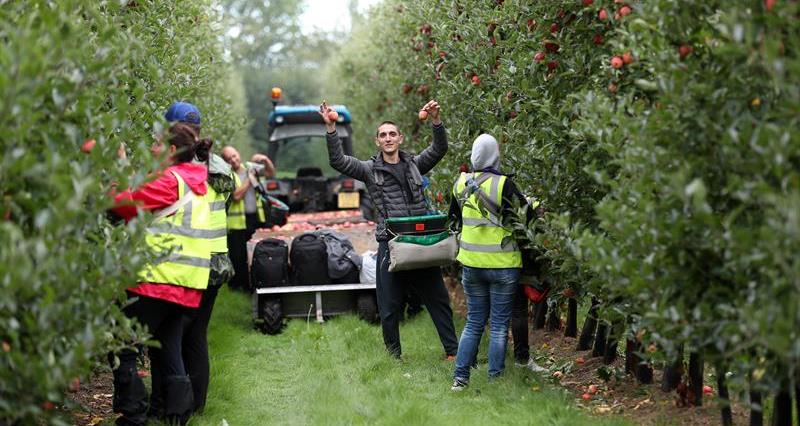
Horticulture Grower Roadshow 2026
Booking for the 2026 Horticulture Grower Roadshows is now open. The roadshows, funded by members of the Seasonal Worker Taskforce are open to all UK horticulture businesses employing seasonal workers whether through the Seasonal Worker Scheme or other recruitment routes.
The roadshows intend to provide updates on the Seasonal Worker Scheme and changes to employment regulation introduced by the new Employment Rights Act.
Select the links below to book an event near you:
- East Midlands, Nottingham – 24 February
- Cambridgeshire, Ely – 25 February
- Scotland, Dundee – 18 March
- Surrey, Godalming – 24 March
- Kent, East Malling – 25 March
- Herefordshire, Ledbury – 31 March
Video helps applicants understand seasonal work
A video, produced by Pro Force, and with support from GLAA and the Work Rights Centre, aims to inform potential applicants about the nature of seasonal work in the UK and to ensure they know their employment rights. With worker welfare being the priority issue for the industry, the video aims to ensure workers know what the work involves, what costs or fees are, or are not, appropriate, and what its like to live and work on farm.
Watch and share:
Seasonal Workers' Scheme - what to expect when working in the UK (Eng) from GLAA on Vimeo.
The GLAA has also teamed up with the operators to encourage the workers to download the Just Good Work mobile app to their smartphones. Thousands of people have downloaded the app which provides workers with critical information and access to help at every stage of their recruitment and employment journey.
Speaking about the measures being taken to ensure workers have a clear understanding of seasonal work in the UK, James Mallick, Compliance and Implementation Director at Pro-Force, said: “Providing open source access to information is vital in helping migrant workers make informed choices. We hope this video helps achieve those aims and supports other worker education projects like the Just Good Work app and the work being done by the International Organisation for Migration.”
Wage requirements
Under the seasonal worker visa scheme rules, visa workers must be paid at least the National Living Wage for each hour worked (which from 1 April 2026 is £12.71) and receive at least 32 hours of paid employment.
NFU Vice-president Rachel Hallos and NFU Horticulture and Potatoes Board Chair Martin Emmett gave oral evidence to the LPC (Low Pay Commission) on 17 July arguing that the National Living Wage must remain affordable for employers.
The Low Pay Commission is expected to publish a consultation in April 2026 to gather evidence on National Living Wage and minimum wage rates to apply from April 2027. The NFU will respond to the LPC consultation, voicing the needs and opinions of NFU member businesses.
Resources
The NFU, other trade bodies, growers, retailers and scheme operators are working collaboratively as part of the Seasonal Worker Taskforce to help safeguard and ensure access to workers’ rights in the UK Seasonal Worker Scheme.
Resources from the taskforce are available to help growers keep up to date with the SWS rules and best practice.
Resources by topic:
- 2025 UK grower seasonal worker toolkit
- Handling grievance resources
- Supervisor training resources
- Accommodation standards
- Ensuring effective transfer arrangements
- Ensuring effective healthcare provision
SWS Taskforce
NFU members who are interested in joining the Seasonal Worker Taskforce in an individual capacity should contact the taskforce secretariat via email at: [email protected].
Changes to the skilled worker route
Changes to the skilled worker visa route which came into effect on 22 July 2025 mean that occupations with a skill level below Regulated Qualification Framework level 6 (degree level) will no longer be eligible for entry into the UK under the skilled worker route.
Under the old rules for the skilled worker route, in place before 22 July 2025, employers were able to recruit overseas workers to work as farmers (occupation code 5111), horticultural tradespersons (occupation code 5112) and Other Agricultural Tradespersons (occupation code 5119).
The numbers of overseas workers coming into the UK under the skilled worker route and working in agriculture and horticulture were low.
The low use of the skilled worker visa route is likely because of the requirement to pay a minimum salary of £38,700 and because of the administrative cost and burden on employers.
Even though overall use of the skilled worker visa route was low in agriculture and horticulture, the changes may have a significant impact on businesses which did utilise this immigration route. If that is the case, please contact us to help the NFU better understand the needs of our members.
Temporary shortage list
A new TSL (Temporary Shortage List) has been set up to provide access to the immigration system for jobs in shortage which have a skill requirement of RQF3 to 5. The bar to get on the list is set very high with strong evidence needed that employers are committed to increasing recruitment from the domestic workforce, jobs are key to the industrial strategy or delivering critical infrastructure. The TSL is very narrow and opportunities for agricultural roles to be included very low.
Please note that recent changes to the immigration system affect the skilled worker route only and do not impact on the seasonal worker visa route.
Labour shortages
The NFU continues to lobby government on behalf of members on the urgency around the supply of seasonal workers and the pressing need for government commitment to the sector.
An NFU survey carried out during 2022, revealed that £22 million worth of fruit and vegetables had been wasted directly because of workforce shortages in the first half of 2022 alone, and the NFU is emphasising the need to avoid risk in the future and to maintain UK food security.
Read more on how we've been representing you:


Extra workers needed portal
Do you need seasonal workers now? A new service from ALP (Association of Labour Providers) aims to match up horticultural and poultry businesses that need seasonal workers with GLAA (Gangmasters and Labour Abuse Authority) licensed labour providers that have workers available.
The ALP has a service to help businesses that have a requirement for seasonal workers with labour providers who have workers available.
The EWNP (Extra Workers Needed Portal) is hosted on the ALP website.
There is no cost to register labour requirements on the EWNP but if an ALP labour provider can satisfy an employer requirement, commercial terms may apply and will need to be agreed between the parties.
Please note that only GLAA (Gangmasters and Labour Abuse Authority) licensed labour providers can supply seasonal workers for the agricultural and food processing and packing industries.
NFU lobbying – seasonal workers
Government publishes its response to the MAC review
The government confirms that growers will be given two years' notice if the scheme were to close. The NFU continues to lobby for a rolling five-year scheme.
Visa allocations confirmed
41,000 visas are allocated for horticulture and 1,900 for poultry.
Scheme extended for a further five years
During the NFU's Conference, the Defra Secretary confirms the visa scheme will be extended for a further five years.
NFU secures more flexibility for Seasonal Worker Scheme
After several years of campaigning, the NFU has secured a change to the Seasonal Worker Scheme which will allow workers to re-enter the country sooner than had been previously allowed.
Due to take effect from 11 November, this allows horticulture workers to work in the UK for up to six months within any 10-month period.
NFU secures five-year extension to Seasonal Worker Scheme
The NFU secures a five-year extension to the scheme.
The news follows years of NFU lobbying for a long-term plan for seasonal workers and was announced as part of a package of measures including a commitment to a further 45,000 visas for 2025.
NFU secures visa ‘reset’
The relaxation to the Seasonal Worker Scheme means that workers can return an extra month earlier in 2023.
NFU successfully lobbies for the removal of the SWS wage
NFU secures scheme expansion to 45,000-55,000 visas
Extra 10,000 visas released
After the NFU submitted detailed evidence to Defra, demonstrating the level of demand from the industry, an extra 10,000 visas were released to bring the scheme total to 40,000.
Seasonal Worker Wages
The Home Office provided new guidance on the wage requirements for seasonal workers recruited under the Seasonal Worker Scheme, in response to our calls for urgently needed clarity.
NFU President Minette Batters pressed Defra Secretary of State George Eustice for clarity on this issue at NFU Conference in February: NFU22: George Eustice on the future of British farming.
At £10.10, horticulture businesses would be facing wage inflation of 13% against the current National Living Wage (NLW), and still 7% above the new NLW rate which comes into effect in April.
The NFU wrote to all the major UK retailers to set out members’ concerns and to highlight the impacts this new wage policy will have.
NFU secures a three-year extension to the scheme
The Home Office announced the Seasonal Worker visa route has been extended until the end of 2024, to allow foreign workers to come to the UK for up to six months to pick edible and, for the first time, ornamental crops.
The extension of the scheme has been a key NFU lobbying ask as part of work that has seen a catalogue of evidence offered to the government.
The scheme also includes an expansion of 40k visas.
NFU works with the DWP to mitigate impact of COVID
With seasonal worker recruitment impacted by COVID restrictions and the introduction of a points based immigration system in January 2021, the NFU and the Department for Work and Pensions (DWP) worked together to identify measures to support UK growers in attracting and retaining domestic workers.
NFU secures another increase to the scheme to 30,000 visas
NFU works with Defra to launch the Pick for Britain campaign
The campaign encouraged domestic workers into seasonal roles.
NFU launches Horticulture Seasonal Worker survey
The survey was completed by 244 horticultural growers, recruiting over 30,000 people. This equates to just under 50% of the workforce.
NFU Deputy President Tom Bradshaw said: "While there was a fantastic response from Brits to the call for domestic workers this year in extraordinary circumstances, we see from the survey results that they only made up 11% of the workforce. Seasonal work on farm simply isn’t a viable solution for many."
NFU secures another increase to the pilot to 10,000 visas
NFU successfully secures an increase to the pilot to 5000 visas
NFU successfully secures a Seasonal Worker Pilot
Horticulture remains the only sector in the entire UK economy to have a ‘low skilled’ immigration route.