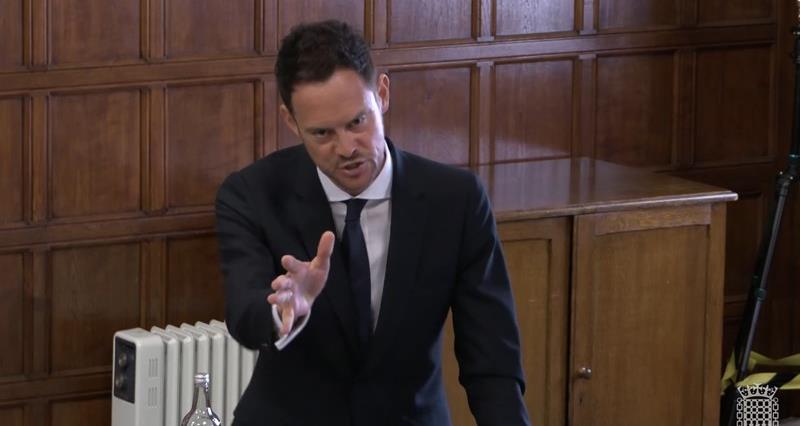
David Smith MP, the Labour MP for North Northumberland, secured the debate, and the NFU External Affairs team briefed MPs beforehand.
MPs clearly recognised the pertinence of the debate, with 26 MPs making interventions, including from the Farming Minister Stephen Morgan MP (Lab, Portsmouth South) who responded to the debate on behalf of the government, the Shadow Farming Minister Robbie Moore MP (Cons, Keighley and Ilkley), and the Liberal Democrats’ farming spokesperson, Sarah Dyke MP (Lib Dem, Glastonbury and Somerton).
Indeed, the debate was so busy that the Chair of the debate, Karl Turner MP (Ind, Kingston upon Hull East), had to limit speeches to only one and a half minutes!
Profitability for farmers
Opening the debate, David Smith told MPs that while the “best beef in the world” was raised in his constituency, farmers are not enjoying the “best cuts” of profitability.
Smith raised figures which said after production and input costs, a cereals farm in 2023/24, would’ve made a loss, noting that it would be relying on subsidies, diversification and ELMs (Environmental Land Management schemes) to make a profit.
Rachel Gilmour MP (Lib Dem, Tiverton and Minehead) also raised the poor profits that many farming businesses receive, and rejected the negative stereotypes of farmers as wealthy, saying “my farmers are not landed gentry. They are people who work with their hands. They are up before dawn, toiling through the winter”.
Smith also noted that British farmers earn “a lower share of food chain gross value added” than farmers in Germany, France or the Netherlands, and referenced the high production costs that British farmers face.
Later, Smith, alongside other Labour MPs Adam Jogee (Newcastle-under-Lyme), Josh Newbury (Cannock Chase) and Sadik Al-Hassan (North Somerset) welcomed the government’s 25-year Farming Roadmap. Smith said he hoped this and the Labour Rural Research Group’s report would push the government to increase farming profitability.
Standing charges raised
Raising a key NFU ask, Smith discussed standing charges, and urged the government to help farmers cut electricity prices by opening a standard industrial classification subdivision for energy-intensive farming, for example for poultry and horticulture farming businesses. This was also raised by Sarah Bool MP (Cons, South Northamptonshire), who, again, raising an NFU ask, argued that the hike in standing charges would drive food inflation.
Showing the NFU’s place as the biggest representative of farming businesses in England and Wales, eight MPs, including Farming Minister Stephen Morgan, spoke fondly of their engagement with farmers in their constituency through the NFU.
Concerns about core standards continue
Smith also said the best way to protect British Farming from external pressures was to ensure imported food products meet the same standards as ones produced in Britain. Smith was joined in this sentiment by Dr Ellie Chowns MP (Green, North Herefordshire), Bayo Alaba MP (Lab, Southend East and Rochford), Maya Ellis MP (Lab, Ribble Valley) and Sarah Dyke.
UK-EU SPS deal raised
Several MPs raised a potential SPS (Sanitary and Phytosanitary) agreement between the UK and the EU, and the potential growth opportunity it could bring British farmers and growers.
Sarah Dyke urged the government to make the agreement as soon as possible, so that “Somerset’s pork, cider and cheese reach European shelves without the paper eating into their profit”. Rachel Gilmour and Steve Witherden MP (Lab, Montgomeryshire and Glyndŵr) also urged the government to make the agreement as soon as possible.
However, David Smith and the Shadow Farming Minister Robbie Moore urged the Farming Minister to ensure that farming businesses were not disadvantaged by the agreement, mirroring the NFU’s concerns.
Moore referenced the report by CropLifeUK, and quoted its figure that if the agreement doesn’t have the correct transition period, it ‘could drain £810 million from UK farmers and sacrifice almost 9,000 jobs’.
ELMs discussed
Julie Minns MP (Lab, Carlisle) voiced her concerns that the first round of SFI funding is opening only for farms under 50 hectares, saying that while she agreed with the principle of supporting smaller farms, the principle that bigger farms are automatically more profitable was wrong. Minns explained that as more than half of the farmland in Cumbria is classified as ‘less favoured area’, they need substantially more land to run functioning businesses.
Minns also said this decision would mean that farms in her constituency would be forced to compete with farms that are “genuinely large in terms of productive output, with farms that are much larger, and often with land agents”, meaning the system may ultimately end up disadvantaging small- and medium-sized farms anyway.
Robbie Moore also warned that the £100,000 cap on ELMs agreements would result in farmers carrying out fewer environmental projects.
Minister responds
Marking his first appearance in a Westminster Hall debate since becoming Farming Minister, Stephen Morgan told the room that the Farming Roadmap would give farmers the “sector confidence to invest, grow, plan for the future and secure farms for the next generation” and spoke of the government’s recent announcement of £53 million of investment into innovation on farms.
The Farming Minister also discussed his recent visit to NFU President Tom Bradshaw’s farm.
When discussing the rollout of the 2026 SFI scheme, Morgan said the schemes are designed to be simpler, fairer and to support the “resilience” of the industry.
Responding to James Naish MP’s (Lab, Rushcliffe) concerns about fertiliser supply and production, the Farming Minister told the debate that the government was “very conscious” of the increases in fertiliser prices, and that his department was communicating with the NFU and other stakeholders on the situation.