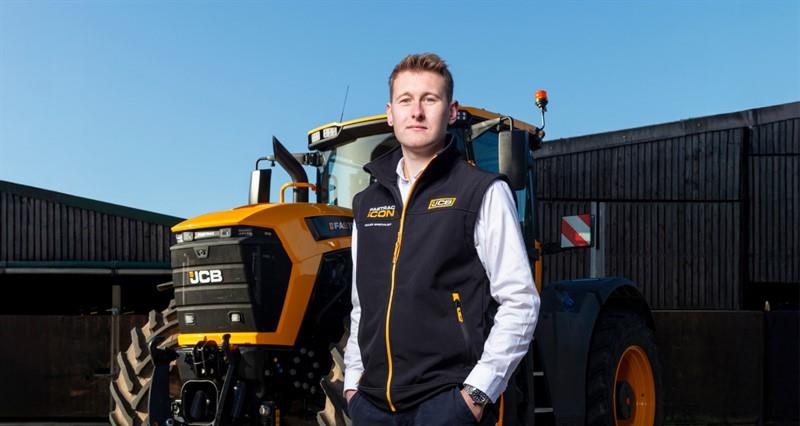
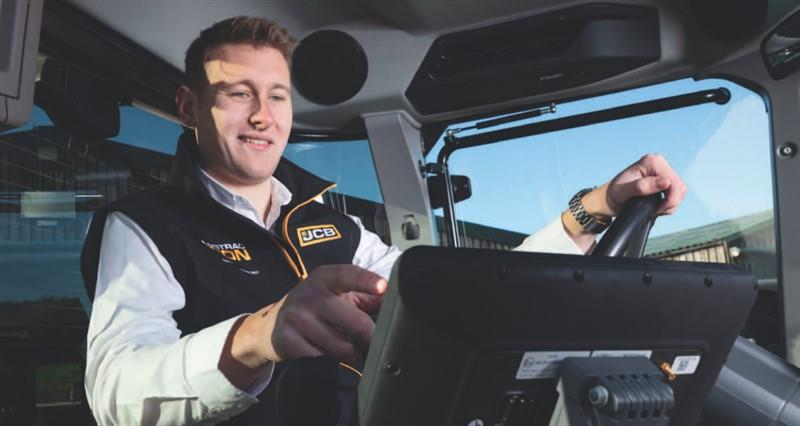
George Elliott is a very difficult guy to pin down. He’s very rarely sat behind a desk, choosing instead to spend his time behind a wheel. One day he’s rolling through Essex in a tractor, the next he’s in a pick-up truck at the tip of Scotland.
‘How did he get so lucky?’ I hear you ask. It’s because George is a sales engineer for one of the world’s biggest machinery brands, JCB, and his job is to travel around the country, demonstrating the latest innovations in agricultural equipment.
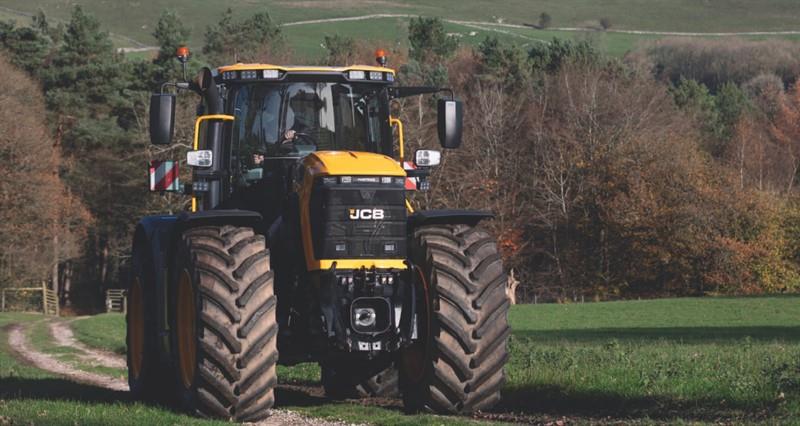
When I spoke to George, he’d just spent six weeks showing off the newest addition to the Fastrac line, the 6000 Series, which launched in October. Packed with new features and gadgets, this bit of kit is one of the most sought after machines on the market – but more importantly to George, it’s one of the reasons why he is where he is today.
“There is a huge opportunity for the next generation of farmers. The jobs that are going to be available in the next 50 years don't even exist now, and that's thanks to precision farming, artificial intelligence and robotics. It's an extremely exciting place to work.”
George Elliott
“[JCB] was developing this tractor when I was on placement with them, and it was so exciting. I wanted to start with them [as a graduate] before they launched the new model just to work with it, so I think I timed it right,” he laughs.
His timing couldn’t be more perfect as in starting with JCB after graduation last year, he’s managed to land his dream job. He’s now a custodian of the Fastrac range of tractors – the iconic mustard-yellow giants – and it’s clear from the passion he has for his work that George understands the weight of the responsibility on his shoulders.
“It’s been quite intense,” he says. “There’s so much to do and a lot of people to get to know in such a short time, but it’s been a great way to get familiar with the industry.”
George tells me the job is more than just talking to customers and operating fancy machinery; there’s a bit of admin and loads of plate-spinning involved, which mixes things up and keeps him on his toes.
Getting his foot in the door
While he’s still got lots to learn, George has certainly given himself a head start. In his third year of university, he did a placement with JCB to learn as much as he could about the machinery sector.
“When it came to finding a placement, I didn’t want to just go and work on a farm. I’d already done that. I wanted to get my foot in the door,” he explains.
“I’d always had in the back of my mind that I’d like to sell farm machinery or work in some kind of precision farming role, and JCB did a business scholarship, which I ended up getting.”
The placement offered him a good variety of work to do – everything from analysing sales data on Excel, to getting out on farm to visit customers. The real highlight was meeting new people and attending the shows and events.
A particular standout for George was a six-week sales training event, where he was able to test his product and company knowledge, having been asked to present to a room full of ag dealers from all over the world.
“I must have done this presentation on the braking system of the Fastrac tractor nearly 200 times, so I was ready for it,” he says. “I thought the whole event was absolutely brilliant. It was so engaging. I was able to talk to people about the interesting things they do with their machines on farm, and I remember thinking, ‘yeah, this is really cool. This is what I want to do’.”
An unconventional path
George studied Agriculture with Mechanisation at Harper Adams University in Shropshire, having taken a rather unconventional path to get there.
Finished with his A-Levels, he worked for a local livestock and machinery auctioneers to understand how the business worked. He did that for a year before deciding to apply for university, only to defer for another two years as he felt the timing wasn’t quite right.
Instead, he got a job on a large fresh produce farm in Lichfield, harvesting carrots and parsnips, which was “one of the best jobs [he’s] ever had”. It was when he turned 21 that he decided the time had come to give university a go.
“I remember thinking, ‘I don’t want to be a tractor driver’. My jobs up until that point had opened my eyes to the world of precision farming and large-scale arable growing. It got me excited to find out more,” he says. “So, I left and went to start my first year at Harper, to my mum and dad’s relief! They always wanted me to go.”
Following his passion
As part of the course, George was able to specialise in what really excites him: digital technologies. Speaking to him now, his face lights up talking about data and how much he enjoyed a module entitled ‘Science, Technology and Information’.
His lecturers would regularly invite someone from industry to come and speak to students about the very latest in precision farming, and it’s no exaggeration to say that George was mesmerised by these presentations.
“I couldn’t believe more people weren’t talking about what I’d heard,” George says. “I thought that there was so much opportunity. This was exactly what I wanted to do. Whether it’s a tractor or a cattle management system, I knew I wanted to work in this area.”
Filling the skills gap
The fact he doesn’t come from a farming family certainly hasn’t held him back from finding his niche within the sector. Indeed, George argues that looking beyond the ‘traditional’ ways of doing things will be absolutely vital for the future of the industry.
“I think, perhaps, it has been widely understood that you’ve got to be from farming to be in farming. It’s what people used to believe, and I don’t think that is the right approach now,” he says.
“If we want to continue to be sustainable, in terms of being a country that produces food well and competes on the global market, then we need to invest in skills and technology.”
The British farming sector is an ageing industry, where the average age of a worker is around 60 years old. George argues that, as a result, there’s now “a massive gap in skills on farms” and prospective farmers will need to hone their digital as well as technical skills in order to grow their businesses.
“Farmers will need skills in things like data analysis and setting up precision farming equipment. In my opinion, farming is going to change more in the next 10 years than it has done since World War II,” he asserts.
“We have never, in recent memory, farmed in a world without subsidies, and we are now starting to enter that world. So, really, how are we going to do this? Wheat prices are high, and the cost of production has increased. We’re going to have to become better at what we do, and this is where, I think, data will help us.”
Future of farming
Sectors adjacent to agriculture are going to drive the sector forward. George says: “People ask me what’s going to drive the change? Will farmers influence companies like JCB to develop new ways of working? Obviously, farmers do have some influence because they have an opinion on what they want to do – but, in the wider scheme of things, I don’t think they will.
"There’s a lot of innovation coming from the companies themselves that farmers aren’t aware of. Companies that analyse agricultural data or produce telematics systems to monitor dairy cow health, and things like that, are the ones that will do it. They’ll help push us forward, and there’s going to be loads of great jobs for people in these areas that want to work in agriculture."
“There’s a lot of doom and gloom in farming at the moment, and that’s because it’s not seen as a particularly prosperous environment; but in spite of this, I am so enthusiastic about the future of farming,” George asserts.
“There is a huge opportunity for the next generation of farmers. The jobs that are going to be available in the next 50 years don’t even exist now, and that’s thanks to precision farming, artificial intelligence and robotics. It’s an extremely exciting place to work.”
It’s hard not to be convinced by George and his enthusiasm. As we say goodbye, I make a mental note to catch up with him in a few years’ time; I’m curious to see what he does next. If we do speak again, I suspect it will be via a phone call from the other side of the world – provided I can track him down first.
The full-length version of this article can be found in the January edition of Student Farmer magazine.