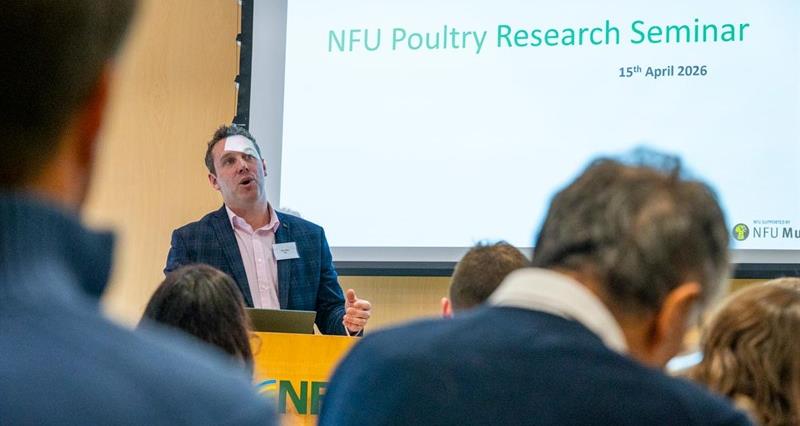
NFU Poultry Chair Will Raw opened the eighth annual Poultry Research Seminar by saying the sector needs evidence to underpin policies when we lobby government.
The seminar, held at the NFU’s Stoneleigh headquarters in April, was instigated by former poultry board chair, Tom Wornham, as a way of linking academic research in the poultry sector with on-farm needs.
This year’s subjects had been suggested by participants in previous seminars and included sessions on bio-char, nano-bubbles and avian influenza.
Innovation and emerging technology
The first session on innovation and emerging technology was kicked off by Richard Pearson of Oxcel Ltd.
Their bolt-on, scaleable medical grade system generates oxygenated nano bubbles in a farm’s water supply and then filters out metals and contaminants.
Farmers who have adopted the technology report that it improves the birds’ gut biomes, facilitates better nutrient uptake, improves the FCR (food conversion ratio) and even keeps the pipes clear. This reduces biofilm in the system that bacteria can thrive on. It also results in drier litter and consequently less hock burn.
Oxcel has run academic trials with SRUC of 12 sets of 20 Ross 308 broilers testing their product against tap water. They have included stress tests with coccidiosis but are struggling to get like-for-like testing on broiler farms due to differing parent flock ages.
Mr Pearson says the Oxcel system increases the dissolved oxygen in the water supply by 400%.
“If we vaccinate 200,000 birds per day and vaccinate at 5km around all infected premises, we can reduce total number of infected farms by 34.5%.”
Prof. Ian Brown, Avian Virology Group Leader, Pirbright Institute
Traffic light welfare system
Prof Marian Dawkins of Oxford University told the seminar that, globally, more than 70 billion chickens are reared for meat each year. Public concern for their welfare is growing but there is currently no easy way of measuring the welfare of living birds.
Most systems are postmortem and measure things like mortality, hock burn and pododermatitis.
Prof Dawkins’ solution is OpticFlock, a 24/7 CCTV system that gives continuous monitoring of living birds, and uses Raspberry Pi-based hardware to plot graphs and data to send to farm staff.
It has been tested on 500 commercial broiler farms in the UK, US, Switzerland and Hungary and measures the movement of whole flocks. OpticFlock has found that unhealthy flocks move differently to healthy ones and have higher levels of mortality and hock burn.
Each day the system produces a traffic light welfare indicator for that flock. Researchers have found that the technology can detect issues in chicks as young as four days old.
Campylobacter can only be detected from cultured fecal saples at 21 days, but Prof Dawkins says that OpticFlock can detect positive flocks from seven days.
Prof Dawkins says that smart tech has to improve welfare and efficiency and has to make sense financially before farmers will adopt it. She says the OpticFlock system can be used in conjunction with others. “We are working with one company that is using water use to decide when to administer vaccines. It can be combined with other data to give better predictions of flock health and progress – we do need collaboration between academia and real farming,” she added.
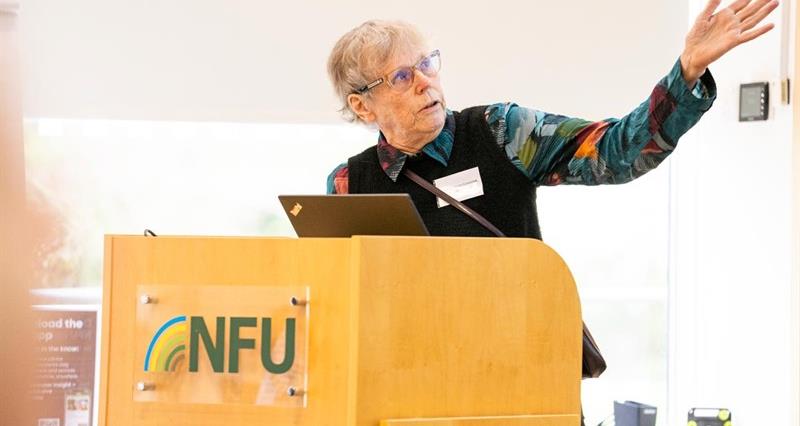
Above: Delegates heard from Marian Stamp Dawkins, Professor of Animal Behaviour, University of Oxford on OpticFlock and the benefits of smart farming
Prof Colin Snape and Associate Prof Helen West of Nottingham University talked about biochar – a stable, carbon-rich material produced from heating biomass in the absence of oxygen. It is a way of sequestering carbon, and two million tonnes of biochar would meet 10% of the UK’s greenhouse gas target.
Biochar can be used to take carbon out of the environment, but it can then be added to soils to improve their water retaining capabilities, or used in syn-gas or bio-oil to create energy.
Assoc Prof West concluded that adding wood-based biochar to poultry litter absorbs nitrogen when composted and stops it leaching from the pile; potassium is slow released; and composting did not help antimicrobial resistance.
When asked what the challenges were to farmers taking up new technology, Prof Dawkins said that more farm trials were needed to demonstrate a good return on investment. Mr Pearson said that his company had better results with smaller farms where the farmer had the power to green light projects.
On-farm animal welfare
The second session was about on-farm animal welfare solutions. Prof Mike Tildesley of Warwick University showed the seminar the computer modelling work his team had been doing to monitor the impact of control measures on the transmission of HPAI in poultry, based on the 2022/23 outbreak.
Some of the work around vaccines has been overtaken by events since the UK started its AI vaccine trial in turkeys. However, the study showed that vaccinating in areas with a high density of infected premises would be most effective.
Prof Tildesley said: “We can determine optimal vaccination radius for a given number of doses. If we vaccinate 200,000 birds per day and vaccinate at 5km around all infected premises, we can reduce total number of infected farms by 34.5%.”
He concluded by saying that researchers would like to investigate whether shared ownership of poultry farms increases transmission risk.
Dr Siobhan Abeyesinghe of the Royal Veterinary College looked at public perceptions on chicken production and bird welfare.
Organisers undertook focus groups and questionnaires of a, mostly, urban audience which was polled as a way of clarifying public perceptions of the industry as some retailers started to transition to slow-growing birds.
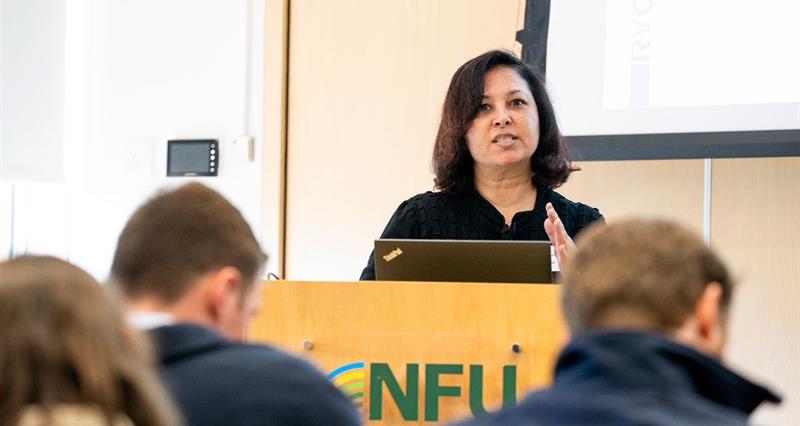
Above: Siobhan Abeyesinghe, Associate Professor in Animal Behaviour and Welfare Science, Royal Veterinary College spoke on breeding for better broiler welfare: balancing sustainability, economic and consumer preferences.
The survey showed some worrying misconceptions. For instance, 68% of people believed that broilers also produced eggs for human consumption and are reared in cages (61%), using antibiotics (48%) and growth hormones (48%).
There was confusion and mistrust over welfare labelling and a general feeling that shoppers will spend money on luxury products that are cheap to manufacture but will not spend extra on meat.
Dan Price of Moredun Research Institute updated delegates on the development of control approaches for red mite.
The ectoparasite has a rapid life cycle going from egg to larvae in seven days and in three of those life stages they take a blood meal from the birds, which can cause huge blood loss and costs the layer sector more than £230m each year.
Researchers think that mites may become resistant to existing treatments, so they are looking for an Achilles heel in the mite’s genome to develop a vaccine.
Avian influenza
Prof Ian Brown of the Pirbright Institute condensed a two-day seminar on the HPAIV FluTrailMap project, which looked at the transmission and risk of AI, into a 45-minute keynote address.
Prof Brown said: “The virus is not standing still – it is constantly changing, which is something we are going to have to consider for vaccination in the future.”
He said the cost benefit on vaccination is not clear at the moment as it is cost prohibitive. Many places are using vaccine strains that are 20 years out of date.
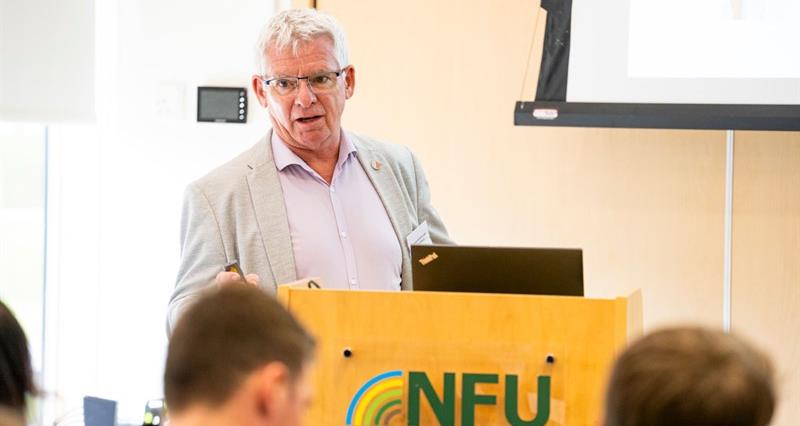
Above: Professor Ian Brown gave a keynote update on HPAIV and the FluTrailMap.
Prof Brown said that the study looked at airborne transmission because it is a concern often raised by farmers. They sampled the air around poultry sheds at the time of depopulation and found the virus can only travel about ten metres.
He said that the transformation of the high path virus from N8 to N1 had added vigour to the virus and the total financial impact of AI was £90.54m in 2021; £227.64m in 2022 and £6.69m in 2023. This includes a lot of processes and costs which tend to be ignored.
Biosecurity fatigue and encouraging consistent compliance is one of the main challenges facing the sector. He concluded by saying that more research on wild birds and ventilation was needed.
Meet the speakers

Will Raw
NFU Poultry Board Chair
During his time on the NFU Poultry Board, Will would like to place emphasis on better UK food security.
He is passionate about promoting the high standards of UK poultry to consumers, stakeholders and politicians.
As a former PIP (Poultry Industry Programme) participant, he was crowned the PIP award winner in 2021, receiving a prize from the Worshipful Company of Poulters.
Will operates a mixed farm in the north of England. The farm comprises 250 acres of combinable crops as well as broilers, supplying the independent poultry sector and growing for Frank Bird.
Alongside the farming enterprise, Will has invested heavily in solar panels and biomass boilers in attempts to achieve net zero.
His farm business has partnered with a farm-based AI company, Pondus. His farm is the principal Research and Development site, and Will is actively involved in the development of their farm management software systems.

Ian Brown OBE
Avian Virology Group Leader, Pirbright Institute
He currently is a member of the UK joint industry and government taskforce on HPAI vaccination.
He is also a member of the World Egg Organisation expert group on Avian Influenza.
Ian holds a visiting Professorship position in Avian Virology at the University of Nottingham.
He has published over 270 peer review papers principally on influenza in animal hosts.
Ian was chair of OFFLU (WOAH-FAO international network for animal influenza) in 2019-2025 and was awarded the OBE in the 2019 New Year’s honour’s list for services to Animal Health and Welfare.
Ian was PI on the FLUMAP project and currently leads Flutrailmap-avian and will present the key findings at the NFU research meeting.

Richard Pearson
Head of Commercial, Oxcel Ltd
Richard has an entrepreneurial drive for innovation and working across the food and farming sectors, developing long-lasting partnerships.

Marian Stamp Dawkins
Professor of Animal Behaviour, University of Oxford
She has recently been involved in the development of an automated system for the assessment of welfare in broiler chickens (OpticFlock) under the SMART BROILER program supported by the Foundation for Food & Agricultural Research.

Dr. Helen West
Associate Professor, University of Nottingham
She obtained her PhD from the University of Glasgow and has held research positions at the Universities of York and Lancaster. Dr. West has been based at the University of Nottingham for more than 25 years, and has developed a long-standing research programme on agricultural waste management and its environmental impacts.
Her work includes collaborations with UK and Argentine partners on poultry manure, as well as research on biochar for improving soil function, nutrient cycling, and mitigating AMR risks.

Mike Tildesley
Professor in Infectious Disease Modelling, University of Warwick
A key theme that spans all areas of his research is the investigation of the role of intervention policies in the control and management of infectious disease outbreaks.
He is Principal Investigator on several multi-institute grants that typically work at the interface between science and policy, focusing upon the development of novel infectious disease models, often in data poor environments and working closely with stakeholders to devise strategies to minimize disease impact.
Specifically, the work of his group focuses upon fitting mathematical models to epidemics and simulating the effectiveness of alternate control policies to establish optimal strategies for disease control in the future.
His models have been applied during outbreaks (most notably the 2001 and 2007 outbreaks of foot-and-mouth disease in the UK, the Covid-19 pandemic and the ongoing H5N1 outbreak in the UK), in the aftermath of outbreaks (e.g. the Japan 2010 FMD outbreak, the 2014 Ebola epidemic) and also for contingency planning purposes for future outbreaks.
Throughout his career he has been involved in communicating with policy makers and advising regarding optimal control strategies to mitigate outbreaks of infectious diseases.
The outputs from his models have been reported directly to agencies such as the Department of Homeland Security, the US Department of Agriculture, the Food and Agriculture Organisation of the United Nations and the World Organisation for Animal Health.

Siobhan Abeyesinghe
Associate Professor in Animal Behaviour and Welfare Science, Royal Veterinary College
Following postdoctoral research and a RCUK fellowship position she was appointed to a Lectureship at the Royal Veterinary College in 2012.
Her research interests cover animal behaviour and welfare with a focus on poultry.
These encompass both fundamental work on perception, cognition, and behaviour as well as more applied multidisciplinary research evaluating welfare during rearing, end of life and in specific situations and collaborating with social scientists to understand societal contexts.

Daniel Price
Researcher, Moredun Research Institute
Through these methods, his overarching goal is to elucidate parasite biology, particularly the mechanisms by which parasites exploit their hosts.
By improving the understanding of host–parasite interactions, Dan aims to inform the development of effective interventions to protect livestock of veterinary importance from parasitic threats.
Colin Snape
Professor, University of Nottingham