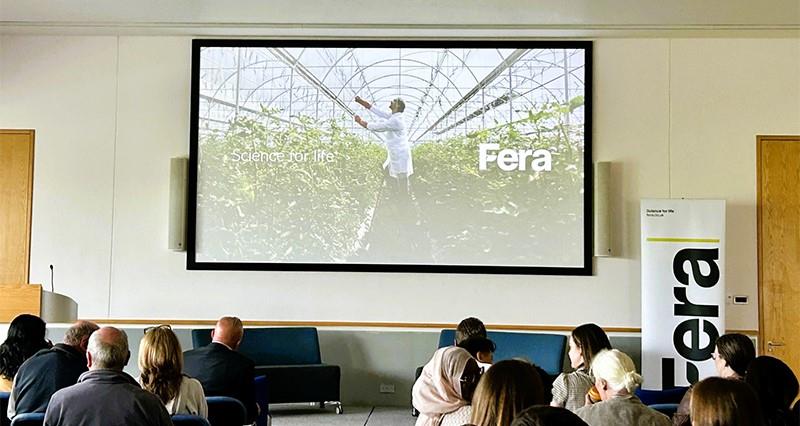
Across two days, the sessions at Fera highlighted a consistent message: credible, transparent, farm‑relevant evidence is essential for shaping policy and supporting on‑farm decision‑making.
Pressures facing horticulture
G’s Fresh set out the scale of pressures facing horticulture, particularly around water availability, land use and the future of the Fens. The business has invested heavily in circular nutrient systems and data‑driven approaches, but warned that policy changes, including the SFI payment cap, risk pushing growers towards more intensive production simply to maintain viability.
Within this, Fenland SOIL was highlighted as a farmer‑led group providing the kind of practical evidence needed when assessing environmental proposals in major food‑producing regions. Their work underlined how essential it is that decisions affecting the Fens are grounded in robust, on‑farm data.
Regenerative approaches at scale
Wildfarmed emphasised that meaningful change requires participation from mainstream, large‑scale producers to generate data. Their work with NIAB and Fera on the 2025 harvest aims to generate consistent, comparable data on biodiversity, soil health, water quality and carbon impacts. The message was clear – regenerative systems must be underpinned by evidence and data if they are to deliver environmental and economic benefits.
Agronomic insight
Hutchinsons provided grounded agronomic insight, highlighting the role of integrated data in supporting crop and soil management.
The Allerton Project shared findings from nearly a decade of regenerative systems trials, reinforcing that soil function and resilience depend on understanding trade‑offs across different soil types and conditions. Weather extremes, weed pressures and drainage constraints remain significant challenges, and flexibility in management is essential.
“The discussions reinforced the need for evidence‑based approaches, long‑term investment and policy frameworks that enable farmers to adopt practices that work for their soils, systems and businesses.”
NFU Science and Innovation Adviser Charlotte Nott
Importance of soil health
Holkham Estate stressed that regenerative, organic and sustainable intensification approaches ultimately converge on the same principle: soil health. Their grazing systems and landscape‑scale management illustrate how environmental outcomes depend on practical, adaptive decision‑making.
The session also highlighted the need for policy frameworks, including the Land Use Framework and SFI, that reflect the realities of farming businesses.
Underpinning resilience
Fera’s own work demonstrated the breadth of applied science underpinning food and environmental resilience. This included research on pollination ecology in legume fallows, invasive species monitoring, food authenticity, biosecurity, and the development of AI‑enabled laboratory tools.
Across these areas, the focus was on generating reliable data to support risk management, regulatory confidence and evidence‑based policy.
Shaping future land use
Sessions on nature markets, environmental monitoring and precision breeding highlighted the growing role of science in shaping future land use and food production.
From DNA barcoding for biosecurity to smart incubators and precision breeding techniques, the event showcased how innovation can support both productivity and environmental outcomes, provided the regulatory and investment frameworks keep pace.
A shared message
Across the symposium, the common thread was clear: credible, transparent, farm‑relevant science is essential for informing policy and supporting productive, resilient and environmentally sustainable agriculture.
The discussions reinforced the need for evidence‑based approaches, long‑term investment and policy frameworks that enable farmers to adopt practices that work for their soils, systems and businesses.
This aligns with the NFU’s call for sustained government funding for pre‑competitive applied research, investment in independent UK research organisations, and a stronger focus on ensuring R&D delivers practical, farm‑ready solutions.
We also continue to press for greater support to help farmers adopt new technologies, recognising that agritech is central to improving productivity, resilience and environmental outcomes.
Members wanting further information on innovation, research programmes or agritech adoption can visit our science and technology cross sector or contact NFU CallFirst on 0370 845 8458.