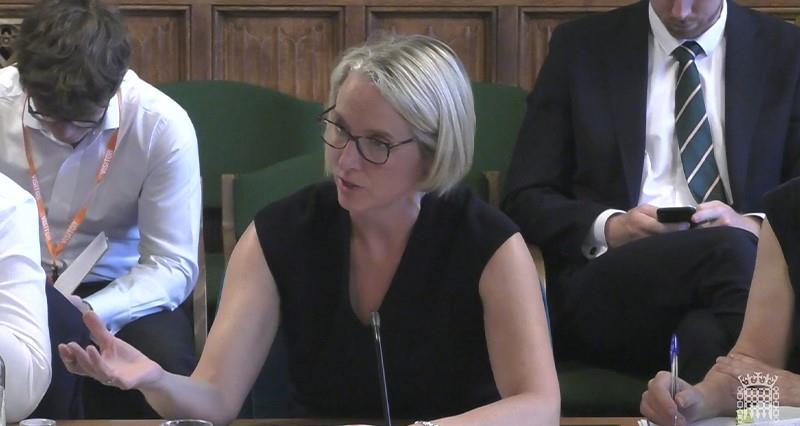
Emma Reynolds, alongside top Defra officials, faced questions on how the government plans to deliver a productive, profitable farming sector and the challenges farmers are currently facing.
The NFU briefed MPs before the committee session to ensure farmers’ concerns were being heard by those in government.
Committee Chair Alistair Carmichael MP (Lib Dem, Orkney and Shetland) asked Reynolds to set out her vision for the future of farming and, in particular, how she planned to deliver growth for the industry.
The Secretary of State raised ongoing work with the NFU on sector growth plans for horticulture and poultry, which are being developed as part of the Farming and Food Partnership Board.
Barriers to growth in poultry sector
Carmichael highlighted the obstacles preventing development and growth in the poultry sector, particularly planning permission, at a time when farmers are being asked to lower stocking densities within poultry sheds.
He pointed to approximately £1 billion of potential investment in the sector currently being held up by the planning system. Reynolds acknowledged the challenges and said that she would also like to see change happening more quickly.
Focus on horticulture
Labour MP for South Norfolk, Ben Goldsborough, who recently attended the NFU Food and Farming Fellowship visit to Barfoots, focused on the horticulture sector. He told Emma Reynolds that high input costs, particularly energy, are a major challenge for horticulture business profitability and international competitiveness. Reynolds said that she wants to bring down the barriers to investment in domestic production.
Goldsborough further asked the Secretary of State whether she is working across government with the Department for Energy, Security and Net Zero and the Treasury, “to ensure that horticultural businesses are not excluded from energy support schemes simply because they fall outside existing classifications”. Reynolds confirmed that inter-departmental discussions are taking place.
The NFU has lobbied government to rethink its introduction of crippling electricity standing charges on farm businesses and called for the inclusion of agriculture in the British Industrial Competitiveness Scheme and the Network Charging Compensation Scheme.
Ben Goldsborough further pressed the Secretary of State on the commercial risks growers face and the need for fairness in the supply chain, asking the Secretary of State to consider introducing a ‘horticulture buyer’s code of practice’, something which the NFU has repeatedly called for. He also questioned Emma Reynolds on planning barriers and the lack of clarity on seasonal workers’ visas.
The Liberal Democrat MP for Glastonbury and Somerton, Sarah Dyke MP, welcomed the recent opening of Window 1 of SFI 2026, but raised concerns about whether funding would match the huge demand from farmers seeking to go further on environmental delivery.
Following the budget announcement in June, the NFU briefed MPs on our concerns that the budget announced will not meet demand, preventing all of those with expiring agreements fair access to continued ELMs (Environmental Land Management Scheme) funding.
Dyke challenged the Secretary of State on whether some farmers, particularly those without professional assistance, would lose out in a competitive first come, first served system with limited budget.
Emma Reynolds acknowledged these concerns and pointed to the steps Defra has taken to allow farmers to prepare their applications in advance. Read more from NFU policy experts about what you can do now to prepare your application.
Dyke also questioned Reynolds on the introduction of spatial targeting in ELMs actions, set out in the Farming Roadmap and likely to be introduced in 2027. She asked whether farmers not in those areas targeted for nature recovery would lose out on ELMs funding. Emily Miles, Director General for Food, Farming and Biosecurity at Defra, told the committee that that aspect needs to be “worked through”. The NFU has been clear that the ELMs offering must be fair, accessible and relevant to all farming businesses.
Josh Newbury MP (Labour, Cannock Chase) raised concerns about the direction of travel for ELMs funding set out in the Farming Roadmap, particularly the greater reliance on private finance, with plans to target public funding for ELMs to where the markets will not pay. Nature markets remain nascent, lacking the clear rules and standards needed to incentivise investment.
Newbury asked whether government would continue to use public money more broadly if nature markets failed to develop sufficiently, but this was not confirmed. He also suggested that nature markets would be difficult to navigate for many farmers and an additional burden to manage alongside the challenges farmers already face.
Alistair Carmichael observed that farmers have already undergone a challenging transition away from basic payments and into ELMs. He asked Emma Reynolds how much money was currently coming in from private finance, and Reynolds told the committee this is unknown.
SPS agreement
Sarah Bool MP (Conservative, South Northamptonshire) focused on the upcoming SPS (Sanitary and Phytosanitary) agreement, stressing to the Secretary of State that the UK must have a seat at the table to influence the EU legislation that it will be subject to under dynamic alignment. Bool also emphasised the importance of proper scrutiny of EU regulations and asked what preparations the department is making to ensure this takes place. She further questioned how government can commit to the delivery of the Farming Roadmap when much of it falls within the scope of SPS.
The NFU continues to make the case to government on the need for thorough parliamentary scrutiny of EU legislation within the scope of dynamic alignment.
Emma Bourne, Director General for EU Reset and Trade, told the committee that Defra continues to work with industry, including the NFU, as well as the scientific community to prepare for the SPS agreement and to ensure that the UK is well represented in EU working groups.
Bool also reiterated calls for the Paymaster General Nick Thomas-Symonds, the minister in charge of SPS negotiations, to appear before the Efra Committee.
Future of livestock farming
Sarah Bool and Alistair Carmichael questioned the Secretary of State on the future of livestock farming in the UK, citing the Climate Change Committee’s Seventh Carbon Budget, which recommended major reductions in UK livestock numbers. Bool asked what certainty the Secretary of State could offer livestock farmers to enable them to plan and invest in their businesses.
Emma Reynolds told the committee that government does not have an opinion on livestock numbers. She pointed to methods such as diet and genetics that could allow domestic meat production to reduce emissions without a decline in the national herd. The NFU has been clear that a thriving livestock sector is a key part of a resilient food system.